
Trying to figure out childcare funding can feel like a maze, but the 30 hours free childcare scheme is a fantastic government support system designed for working families in England. It's a real game-changer, giving you up to 1,140 funded hours of childcare a year to make balancing work and family life that bit easier.
Understanding The 30 Hours Free Childcare Scheme
So, what does "30 hours free childcare" actually mean? It’s not cash given directly to you. Instead, think of it as the government paying for a big chunk of your child's nursery place. The money goes straight from them to your chosen, approved provider.
This funding is there to cover the cost of a set number of hours each week, taking a significant weight off your shoulders financially. And the good news is, the scheme has recently been expanded, meaning this support is now rolling out for younger children, offering a vital lifeline to parents much earlier.
What The Scheme Provides
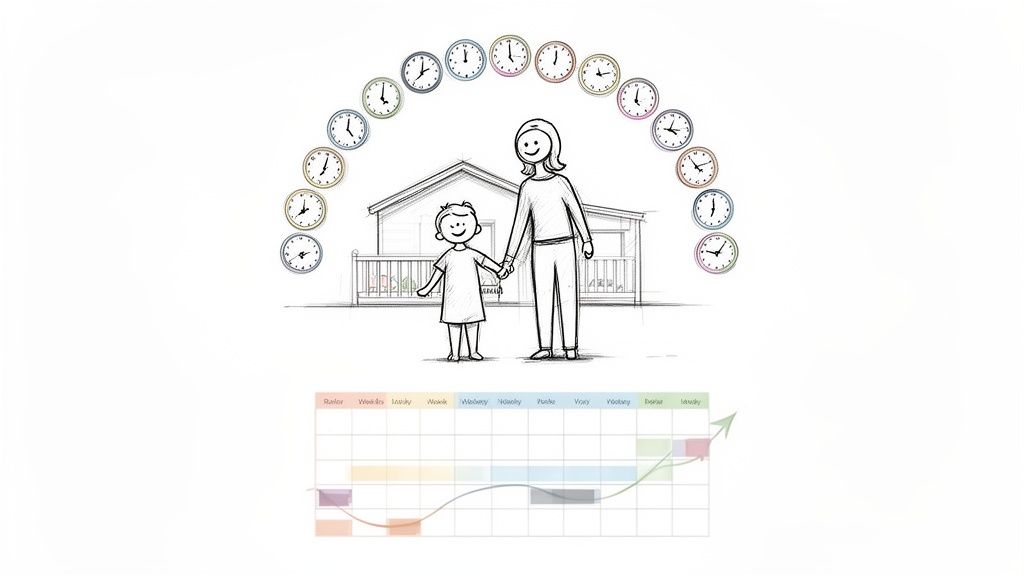
Let's break down what those 1,140 hours a year actually look like in practice, because you have a couple of options for how to use them.
- The 'Term Time' Option: The most common way to use the funding is for 30 hours a week over 38 weeks, which neatly matches up with school term times.
- The 'Stretched' Option: Many nurseries offer what’s called a “stretched offer.” This is a brilliant option for parents who need childcare all year round. The 1,140 hours are simply stretched across 52 weeks, which works out as fewer funded hours per week, but gives you consistent cover without those long holiday gaps.
This flexibility means you can choose a model that genuinely fits your family's routine, whether you're a teacher who only needs term-time cover or you work year-round.
Many nurseries see this scheme as so much more than just a financial saving. It's a true investment in a child's future, giving them access to a wonderful learning environment where they can blossom, make friends, and build the confidence they need for school.
Getting your head around how to apply for and use this funding is the first step. This guide has been designed to walk you through who’s eligible, how the application works, and what it all means for your family. For a full overview of the different types of support available, you can learn more about government funding for nurseries and find what's right for you. The goal is simply to make it all feel clear and manageable.
Checking If Your Family Is Eligible
So, you’ve heard about 30 hours free childcare, but the big question is: can my family actually get it? This is the first hurdle for every parent, and while the government's rules can seem a bit complicated at first, they're really just there to make sure the funding goes to working families.
At its heart, the scheme is designed for parents who are in work. This usually means that both you and your partner (if you have one) need to be earning at least a certain amount each week. Think of it as the equivalent of working 16 hours per week at the National Minimum or Living Wage.
This flowchart is a great way to quickly see if you tick the main boxes for the government's childcare support.
As you can see, it mostly comes down to your work and income, and of course, your little one being the right age.
To give you a clearer picture, here’s a quick summary of the main points.
Quick Eligibility Checklist For 30 Hours Free Childcare
| Criteria | What This Means For You |
|---|---|
| Child’s Age | Your child must be the correct age for the scheme (currently 9 months). |
| Your Work Status | You, and your partner, must be in work (including self-employed or on leave). |
| Minimum Income | You must each earn, on average, at least the equivalent of 16 hours a week at the National Minimum Wage. |
| Maximum Income | Neither you nor your partner can have an ‘adjusted net income’ of over £100,000 a year. |
| Your Location | You must live in England. |
This table should help you quickly gauge where you stand, but let’s dive into the money side of things, as that’s where most of the questions come up.
The Key Income Rules Explained
The government has put two main financial rules in place. It’s not as scary as it sounds – one is a minimum to show you’re working, and the other is a maximum cap.
1. The Minimum Earnings Threshold
This is to ensure the scheme helps parents who are in regular employment. As mentioned, you need to earn at least what you’d get for working 16 hours per week at the National Minimum Wage. It’s important to realise it’s not about the number of hours you work, but the amount you earn.
2. The Maximum Income Cap
There’s also an upper limit. If either you or your partner has an ‘adjusted net income’ over £100,000 in the current tax year, you won’t be eligible. This is an individual cap, so if one of you earns over this amount, your family won’t qualify, even if the other partner earns very little.
What About Special Circumstances?
Of course, life isn’t always neat and tidy, and the good news is the rules have some built-in flexibility for different family situations.
You might still be eligible in these common scenarios:
- You’re Self-Employed: If you’ve started your own business within the last 12 months, the minimum income rule doesn’t apply. This gives you a bit of breathing room to get things off the ground.
- You’re on Leave: Taking maternity, paternity, adoption, or sick leave? No problem. You’re still treated as meeting the income requirements.
- One Parent Can’t Work: In a two-parent family, if one parent works and meets the criteria but the other is unable to work because they are a carer (and receiving certain benefits) or have a disability, you can still qualify for the funding.
The main thing to remember is that the scheme is designed to be inclusive for working families. If you think you’re on the borderline, it’s always worth double-checking your specific situation on the government’s official eligibility checker.
Once you’ve got your head around these rules and feel confident you qualify, the next step is applying for your childcare code. It’s a pretty straightforward online process, and for many parents in Northwood, it’s the key to making their household budget work that little bit better.
How To Apply For Your Childcare Code
So, you’ve checked the eligibility criteria and it looks like you qualify for 30 hours free childcare. Fantastic! The next step is getting your hands on your unique eligibility code.
Think of this code as the key that unlocks your funding. It’s what you’ll pass on to your chosen provider so they can claim the funded hours for your child. The whole process is handled on the government’s official website, and with a bit of prep, it’s actually pretty straightforward.

Let’s walk through exactly what you need to do, from gathering your details to making sure you don’t miss any important deadlines.
Preparing For Your Application
Before you dive into the online form, taking a few minutes to get your information together will save you a lot of time. It makes the whole thing much smoother.
For you and your partner (if you’re applying as a couple), you’ll want to have these details ready:
- Your National Insurance Number
- Your Unique Taxpayer Reference (UTR), but only if you’re self-employed
- Details of your income, as you’ll need to confirm you meet the earnings threshold
- The date you started your current job
With this info at your fingertips, the application shouldn’t take more than about 20 minutes to complete in one go.
The Step-By-Step Application Process
The application itself is done online through the GOV.UK website. The system guides you through a series of questions about your circumstances to officially confirm you’re eligible for 30 hours free childcare.
Once you hit submit, the system checks everything against government records. For most people, the decision is instant, and you’ll get your 11-digit eligibility code right away. You’ll find it waiting for you in your secure government childcare account.
This is the all-important code you need to give to your nursery. They use it to validate your eligibility with the local authority and make sure the funding is correctly applied to your fees.
Sometimes, the system might need a bit more information and ask you to upload extra evidence, like a recent payslip. Don’t worry if this happens – it’s a standard part of the process. Just make sure to respond quickly to avoid any hold-ups.
Understanding Key Application Deadlines
Getting the timing right is crucial. To have your funding ready for the start of a new term, you must have applied and received your code before the term’s cut-off date. If you miss it, you’ll unfortunately have to wait until the next term begins to start using your funded hours.
Here are the deadlines to circle on your calendar:
- 31st March for funding to start in the summer term (from 1st April)
- 31st August for funding to start in the autumn term (from 1st September)
- 31st December for funding to start in the spring term (from 1st January)
It’s always a good idea to apply well before these dates. It gives you a buffer to sort out any issues and helps secure your child’s funded place, which is especially important for parents looking at nurseries in Northwood where demand can be high.
Reconfirming Your Details Every Three Months
Getting your code isn’t a one-and-done task. To keep your 30 hours free childcare funding active, you must reconfirm your eligibility every three months. This is a really important step that’s easy to forget in the hustle and bustle of family life.
The government will send you text and email reminders four weeks before your deadline. The good news is that it’s much quicker than the first application – you just log in to your childcare account and confirm your details haven’t changed.
If you forget, your code will expire, and you’ll enter a ‘grace period’. This means your child can keep their funded place for a short while, but the funding will stop if you don’t reconfirm. Setting a recurring reminder on your phone is the safest way to make sure you never miss it.
How The 30 Hours Funding Works At Nursery
So, you’ve got your eligibility code for 30 hours free childcare – fantastic! The next step is figuring out what that actually looks like day-to-day at nursery. It can feel a bit confusing at first, especially the word ‘free’, but it’s quite straightforward once you break it down.
Essentially, the government funding gives you a total of 1,140 hours of childcare a year. The great thing is, you have some flexibility in how you use them. Many nurseries offer a couple of different ways to spread these hours, so you can pick the one that fits your family’s routine best.
Term Time Vs The Stretched Offer
You’ve probably heard of the term-time model, which mirrors the school year. But for many working families, what’s known as the ‘stretched offer’ is an absolute game-changer. It means you get consistent childcare cover all year round.
Here’s a quick comparison of the two main ways you can use your 1,140 annual hours.
| Funding Model | Weekly Hours | Duration | Best For |
|---|---|---|---|
| Term Time Offer | 30 hours per week | 38 weeks a year | Families who don’t need childcare during school holidays, such as teachers. |
| Stretched Offer | Around 22 hours per week | 51 weeks a year | Families who need consistent, year-round childcare without long breaks. |
The stretched offer is by far the most popular choice for parents at many nurseries. It spreads your funded hours more thinly across the year, which helps keep monthly bills predictable and avoids the scramble for childcare during the long school holidays.
Why Are There Still Charges To Pay?
This is easily the most common question parents ask, and it’s a really important one. Why is there a bill to pay if it’s called 30 hours free childcare?
The simple answer is that the government funding is designed to cover the cost of your child’s early years education and care, but not the day-to-day extras. Think of it this way: the funding pays for the brilliant staff, the learning environment, and the educational activities. It doesn't, however, cover the costs of things like food, nappies, or specialist sessions.
It's crucial to know that nurseries can't charge you for the funded hours themselves. The funding goes directly from the government to the provider. What they do charge for are the additional goods and services that make up a full day of fun, comfort, and enrichment for your child.
These additional charges typically cover all the essentials that keep your little one happy and healthy, including:
- Meals and snacks: Freshly prepared, nutritious breakfasts, lunches, hot teas, and snacks.
- Consumables: Nappies, wipes, sun cream, and other personal care items.
- Extra-curricular activities: Fun sessions like music, yoga, or sports, which aren't covered by the base funding.
- Resources: Art supplies, sensory materials, and other learning resources used every day.
Nurseries should be completely upfront about costs. When you visit, they should give you a clear breakdown of their fee structure, showing you exactly what’s included in your funded hours and what any additional charges are for. There should be no hidden surprises.
It's always a good idea to ask how sessions are structured and what a typical day looks like. Getting a feel for the routine in the nursery rooms for two to five-year-olds will give you a much clearer picture of how the funding works in practice and all the amazing things your child will get to do.
Combining Funding With Other Support Schemes
A common question is whether the 30 hours free childcare offer can be used with other types of financial help. The great news is, yes it can! Think of the 30 hours as your foundation, and other schemes as ways to cover any extra costs that pop up.
Layering your support is a brilliant way to make your childcare budget stretch even further. It's especially handy for things the main funding doesn't cover, like extra sessions beyond your funded hours, hot meals, or special activities. You just need to know which schemes play well together.
The two most common options you can pair with your 30 hours are Tax-Free Childcare and the childcare element of Universal Credit. Let's break down how you can get them working for you.
Using Tax-Free Childcare Alongside Your Funding
Tax-Free Childcare is a government-run online account. It’s simple: for every £8 you put in, the government adds £2 on top. This boost is capped at £500 every three months (that’s up to £2,000 a year) for each of your children.
This makes it the perfect partner for your 30 hours free childcare. You can let the funding cover the core nursery hours, and then use your Tax-Free Childcare account to easily pay for everything else.
Here’s what that might look like in a typical month:
- Your child attends a few extra hours that aren't covered by the 30 hours funding.
- You also have a charge on your invoice for lunches and snacks.
- You simply pay this remaining balance from your Tax-Free Childcare account, and the government’s 20% top-up helps to lower the final bill.
It's a really practical and popular way for parents to keep their monthly nursery costs down.
How Universal Credit for Childcare Fits In
If you receive Universal Credit, you can also get help with your nursery fees. This isn't a separate application; it’s built right into your existing Universal Credit claim. If you're eligible, you can claim back up to 85% of the childcare costs you pay for.
The key thing to remember is that you can claim this help for any costs that are not covered by your 30 hours funding. This means it can be used for extra hours or for charges for meals and other services.
The process is straightforward. First, you pay your monthly nursery invoice. Then, you simply report what you’ve paid through your online Universal Credit journal. The amount you can claim back is then calculated and added to your next Universal Credit payment.
By cleverly combining these schemes, many families in Northwood are able to make high-quality nursery education a much more affordable reality.
Your Next Steps To Securing A Place
Getting your head around childcare funding can feel like a massive task, but honestly, once you know the steps, it’s much more straightforward than it looks. You've now got a solid grasp of how the 30 hours free childcare scheme works, from who gets it to what it looks like in a real nursery week. The secret is simply to get organised and start the ball rolling early.
It all boils down to a few simple actions. Let's break them down so you know exactly what to do next.
A Simple Action Plan
To keep things clear and stress-free, here’s a simple three-step plan to get you from here to a secured nursery place:
-
Check Your Eligibility Online: First things first, jump on the official government checker. This will quickly confirm if your income and work situation fit the criteria for the scheme.
-
Apply Before The Deadline: Once you’ve got the green light, complete the online application. You’ll be given a unique 11-digit code, which is what you'll give to your chosen provider. Just be sure to get this done before the termly deadlines: 31st March, 31st August, or 31st December.
Applying for a place from January 2027? Our guide to free childcare from January 2027 covers the key dates, who is eligible and a simple December checklist.
-
Talk To Local Providers: Start chatting with nurseries in your area. Ask how they offer the funded hours, if they have a ‘stretched offer’ over the holidays, and what extra costs to expect for things like meals, nappies, or special activities.
Taking this approach means no last-minute panic, and it gives you the breathing room to find a nursery that feels just right for you and your little one.
Nothing beats seeing a place for yourself. Taking the time to visit a nursery is the most valuable thing you can do. It's your chance to get a feel for the atmosphere, meet the team who will be looking after your child, and ask all those specific questions about how your funded hours will work.
If you’re looking at different nursery schools near me in the Northwood area, booking a tour is the perfect next step. It's the best way to see how 30 hours free childcare can support your family and to chat through your specific needs. Making an informed choice now is the key to a happy and smooth start for your child.
Frequently Asked Questions
We know that figuring out the ins and outs of the 30 hours free childcare scheme can feel a bit daunting. You’re not alone! To make things easier, we’ve put together answers to the questions we hear most often from parents just like you.
What Happens If My Income Changes And I’m No Longer Eligible?
This is a common worry, but there’s a safety net built into the system. If your circumstances change and you no longer meet the income criteria, you won't lose your funding straight away.
Instead, you’ll enter what’s known as a ‘grace period’. This allows your child to keep their funded place for a set amount of time, giving you a chance to find new work or for your situation to settle without disrupting their routine. Your nursery can talk you through the specific length of the grace period that would apply to you.
Can I Use The Funded Hours With More Than One Childcare Provider?
Yes, you can! The scheme is designed to be flexible. You’re welcome to split your funded hours between a maximum of two different registered providers in a single day.
For instance, you might want your child to spend some time at a nursery and the rest of their funded hours with a childminder. All you need to do is give your eligibility code to both settings and agree with each of them how you’d like to split the hours. This just makes sure everyone claims the correct funding.
Do I Have To Use All 30 Hours Every Week?
Not at all. The offer is for up to 30 hours, which means you only have to use what you actually need.
How many hours you use will ultimately depend on your family’s schedule and the session times a nursery has available. The important thing to know is that you won’t lose your eligibility for the scheme simply because you don’t use the full 30-hour entitlement.
What Is Not Covered By The Government Funding?
This is a really important one for budgeting. The government funding is specifically for the cost of your child’s care and early years education. It doesn’t cover the day-to-day extras.
Things that are typically charged for separately include:
- Meals, from breakfast and lunch to snacks
- Consumables like nappies, wipes, and sun cream
- Extra-curricular classes, like special music or sports sessions
- Any trips or outings that come with an extra cost
Most nurseries charge a separate fee for these items to cover their costs. They should always be happy to give you a clear, detailed breakdown of any additional charges so you have a full picture of your monthly fees right from the start.
Hopefully, that clears a few things up! If you have any more questions about your family’s specific situation, please don’t hesitate to get in touch with our team for a friendly chat.