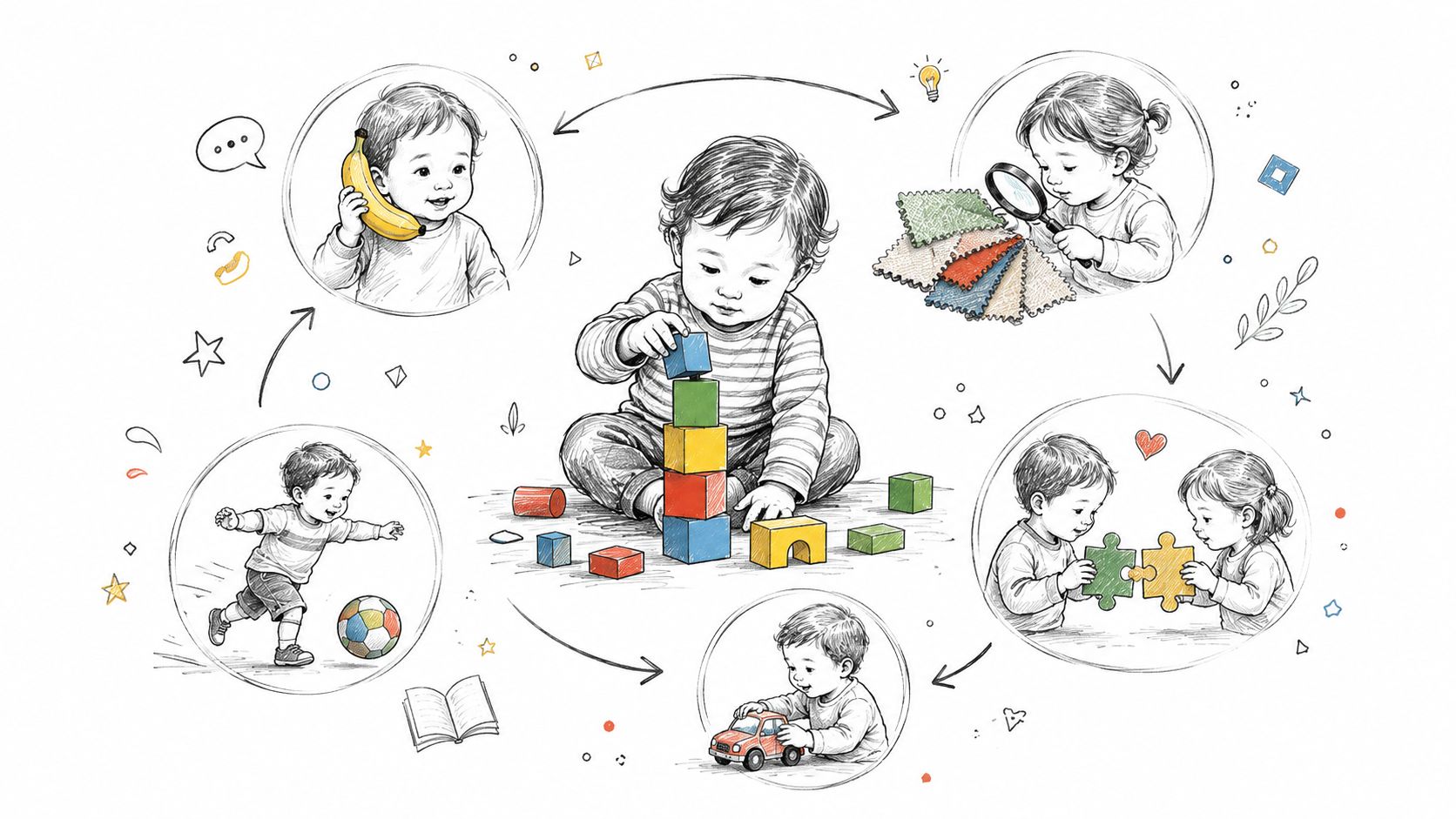

Your child is scattered with blocks on the carpet, making engine noises with a toy car, then suddenly deciding the spoon is a telescope. It can look like random fun from the outside, but those moments are often full of real learning. Parents usually sense that play matters, they just don't always have the words for what their child is doing.
Understanding the types of play makes everyday behaviour easier to read. It helps you see when a child is building, pretending, exploring, moving, or practising social skills, and it gives nursery staff a shared language for what they notice each day. That matters because UK early years practice has moved away from treating play as one loose idea, and now recognises many distinct forms as part of development, from movement and make-believe to construction and rule-based interaction, as described in the Welsh play-types resource (play-types resource).
It also helps to remember that play is not just a warm-up before “real learning” starts. In early years settings, play is often the main way children build language, social understanding, problem-solving, and physical coordination, which is why the atmosphere of a nursery can look busy, noisy, and slightly chaotic while still being purposeful. For a wider look at how play supports young children, see The Power of Play at Happy Tree Academy.
Understanding Why Play Types Matter
A parent watching a child on the floor with a pile of cups may only see a mess. A practitioner will often see concentration, repetition, balance, problem-solving, and early mathematical thinking all happening at once. That's the value of understanding types of play, it lets you notice the learning inside what looks ordinary.
What children are really doing when they play
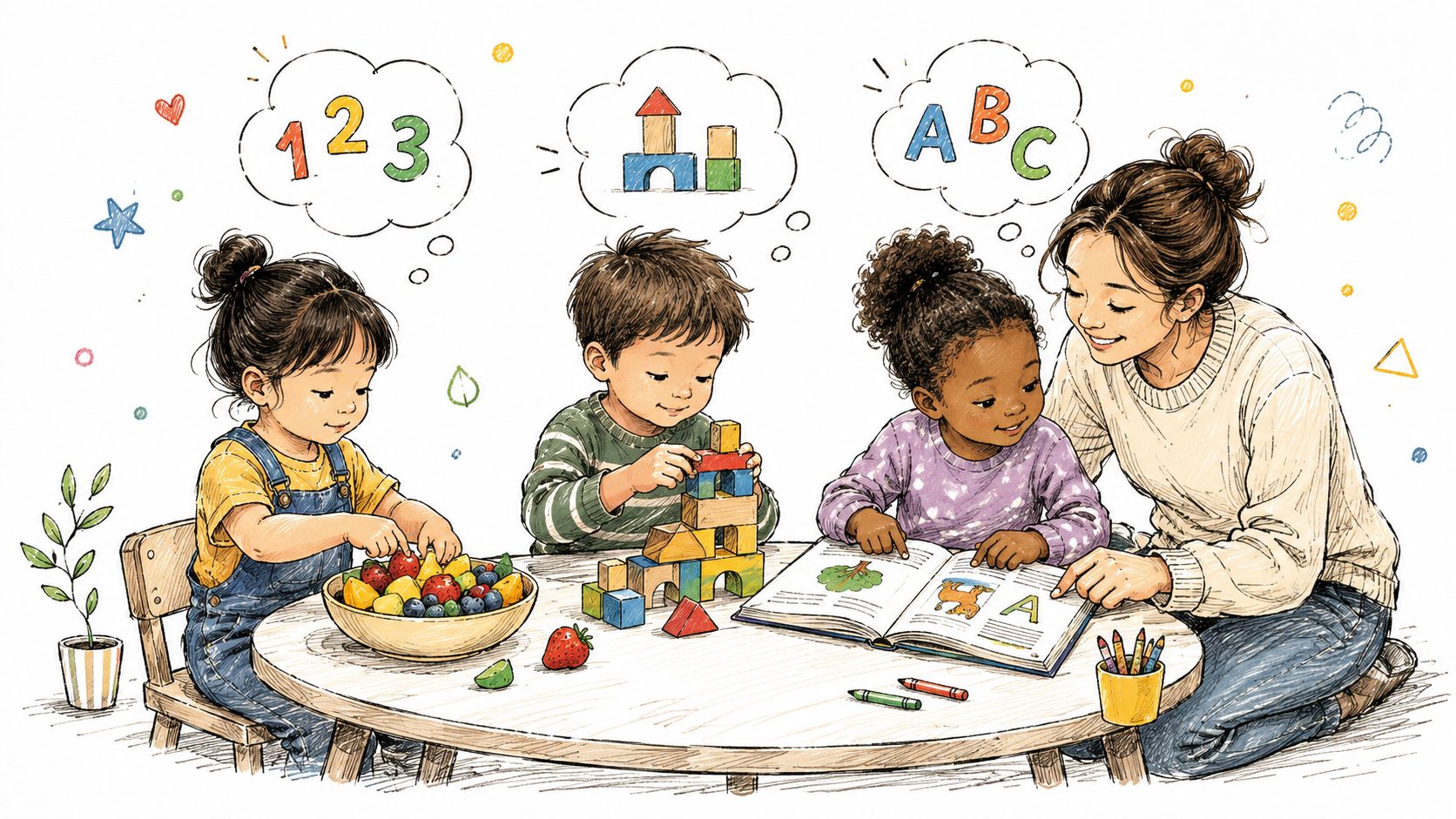
When a child stacks blocks, they're not only “keeping busy”. They're testing cause and effect, hand-eye coordination, and patience. When they pretend to serve tea, they're rehearsing language, social roles, and turn-taking. When they run round the garden, they're practising body control, speed, and confidence in their own movement.
Early years practice in the UK now works with a more precise view of play than the old catch-all word “play” suggests. Professionals often separate object play, locomotor play, creative play, dramatic play, mastery play, social play, and socio-dramatic play so they can observe children more accurately in real settings (Welsh play-types resource). That kind of observation helps adults understand what a child is ready for next.
Practical rule: if a child keeps returning to the same activity, don't assume they're bored. Repetition often means they're refining a skill.
Why this matters for parents
It can be reassuring to know that children don't need every play moment to look educational in a formal way. Sometimes learning comes through quiet experimenting. Sometimes it comes through noise, movement, and make-believe.
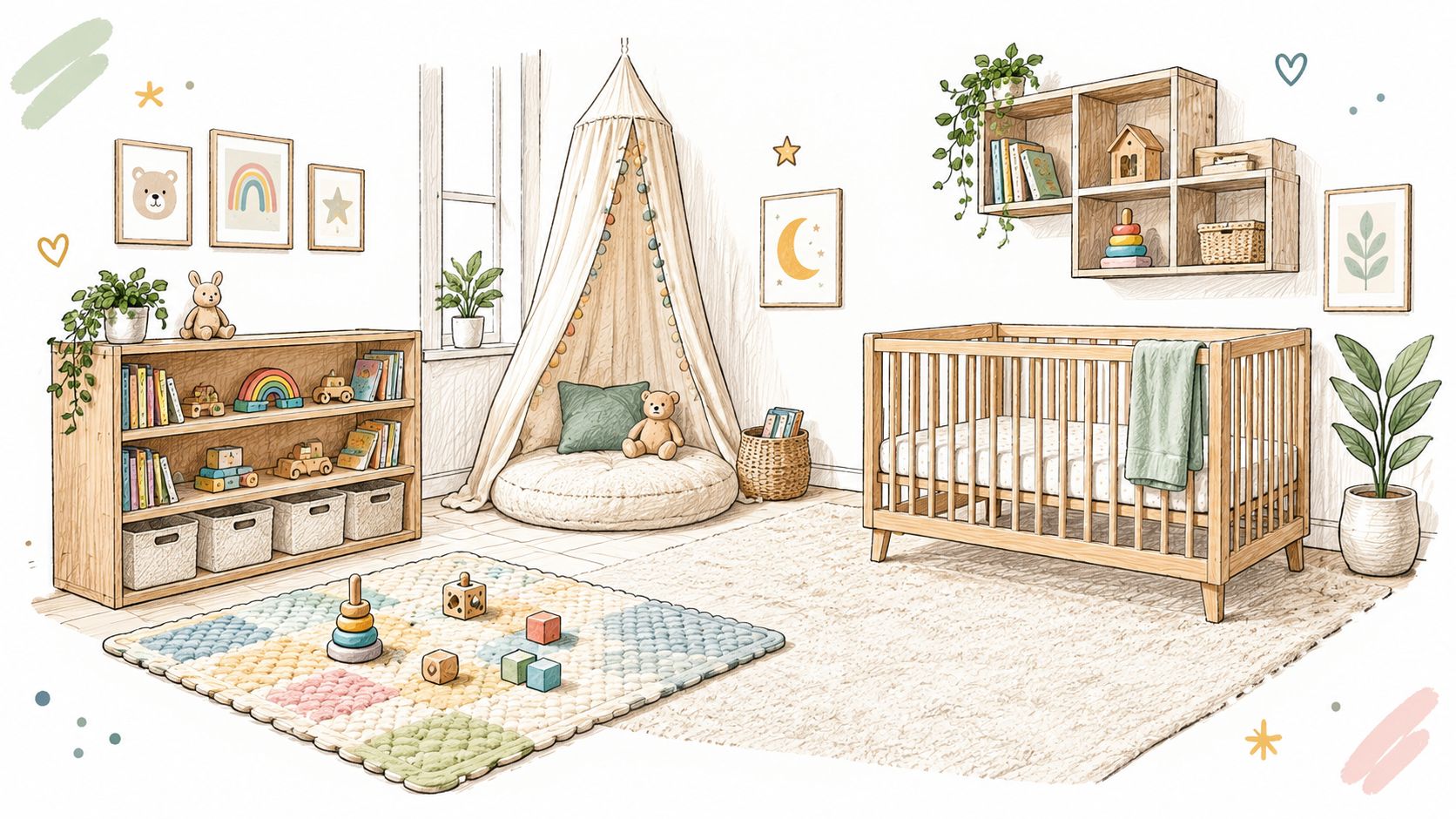
This also explains why nursery environments are usually set up with different areas. One space might invite small-world play or construction, another might support movement, and another might encourage pretend roles. A child does not need to use every corner in the same way, because different types of play meet different developmental needs at different times.
For many parents, this shifts the question from “Is my child playing properly?” to “What skill is this play building?” That small change makes a big difference, especially when your child seems to favour one kind of activity for a while. It's often a sign that they're working hard at something specific, not that they're falling behind.
The Main Categories of Play in Early Years
Most early years frameworks group play into a few broad categories so adults can recognise patterns rather than judge isolated moments. The language varies across resources, but the core ideas are familiar: children use their bodies, objects, symbols, imagination, and rules in different combinations as they grow.
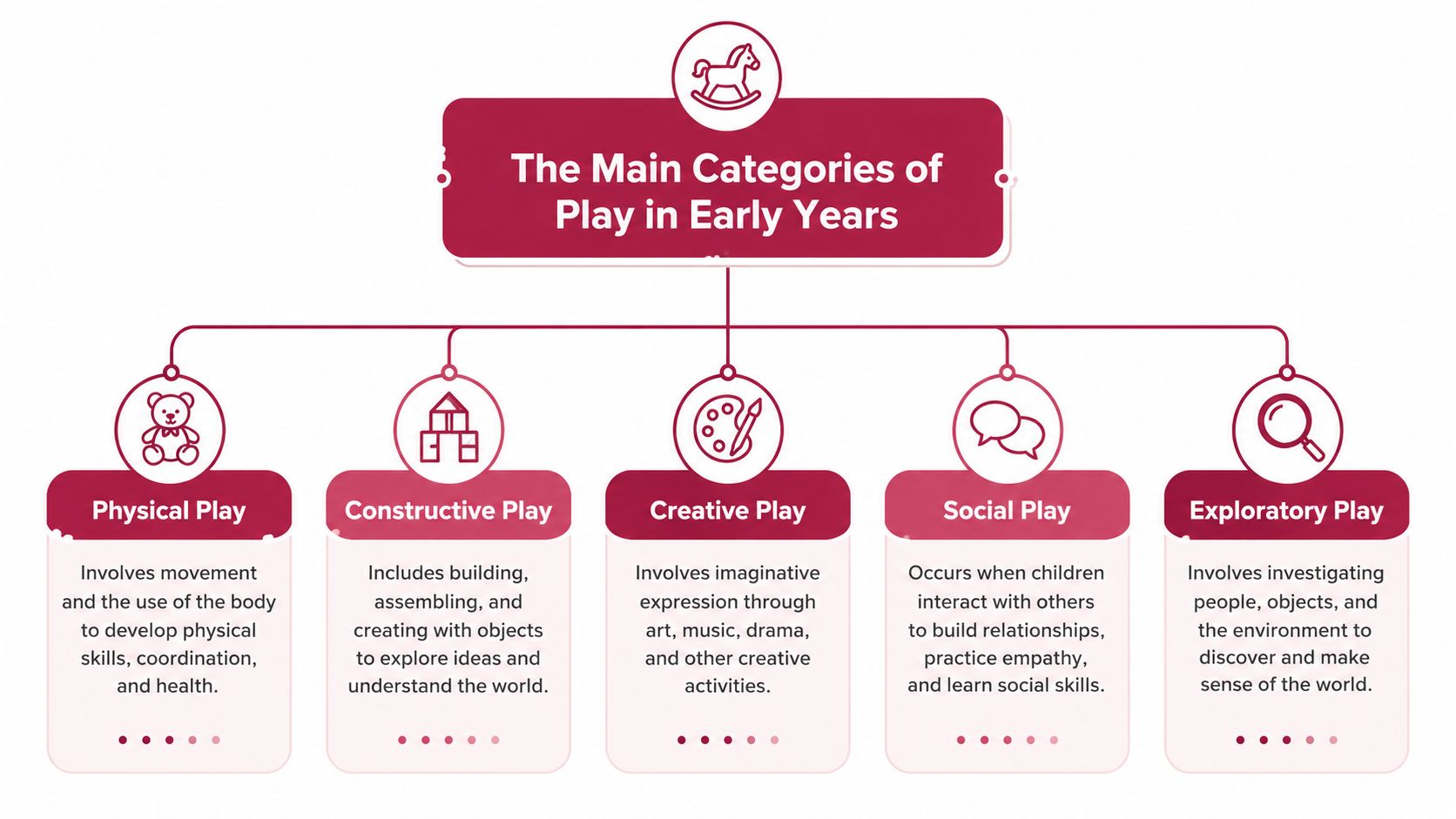
The main groupings parents are most likely to notice
One useful way to think about play comes from developmental psychology. Piaget-based early years theory commonly describes functional play, symbolic play, and games with rules, while Smilansky later added constructive play as a fourth level (play theory summary). Another learning resource groups play into functional, symbolic, constructive, and games with rules, and breaks those down further into exploratory, pretend, dramatic, creative, competitive, and rule-bound forms (learning-through-play guide).
That sounds technical, but the everyday examples are simple.
- Functional play: repeating actions for their own sake, such as rolling a ball, filling and emptying, or banging two blocks together.
- Symbolic play: using one thing to stand for another, such as a stick becoming a sword or a blanket becoming a cape.
- Constructive play: making something with a purpose, like a tower, a road, or a den.
- Games with rules: following shared rules, waiting turns, and accepting limits.
These categories are not strict boxes. A child building a garage with bricks may be doing constructive play, but they might also move into symbolic play if the garage becomes part of a pretend rescue scene. That overlap is normal and healthy.
Why nurseries watch for these categories
Nursery staff use these ideas because they need to see what kind of support will help most. A child who is mainly experimenting with objects may need open-ended materials. A child deep in pretend play may need language-rich prompts. A child beginning to join rule-based games may need help with turn-taking and frustration.
A practical example is constructive play. Classic summaries of play note that preschool children often choose constructive play more than 50% of the time when given a choice, which shows how naturally children lean towards making, sorting, and building when the environment allows it (play resource on early categories). That doesn't mean every child will do this every day, but it does explain why blocks, loose parts, and art materials matter so much in early years rooms.
Once you recognise the categories, you start seeing how much variety there really is inside a nursery day. That variety is intentional, and it supports children in different ways.
Exploring Each Play Type and Its Benefits
Some play types are easy to spot because children use their whole bodies. Others are quieter and look almost invisible until you know what to watch for. A child nibbling a safe sensory texture, a toddler stacking cups, and a preschooler pretending a banana is a phone are all doing very different work.
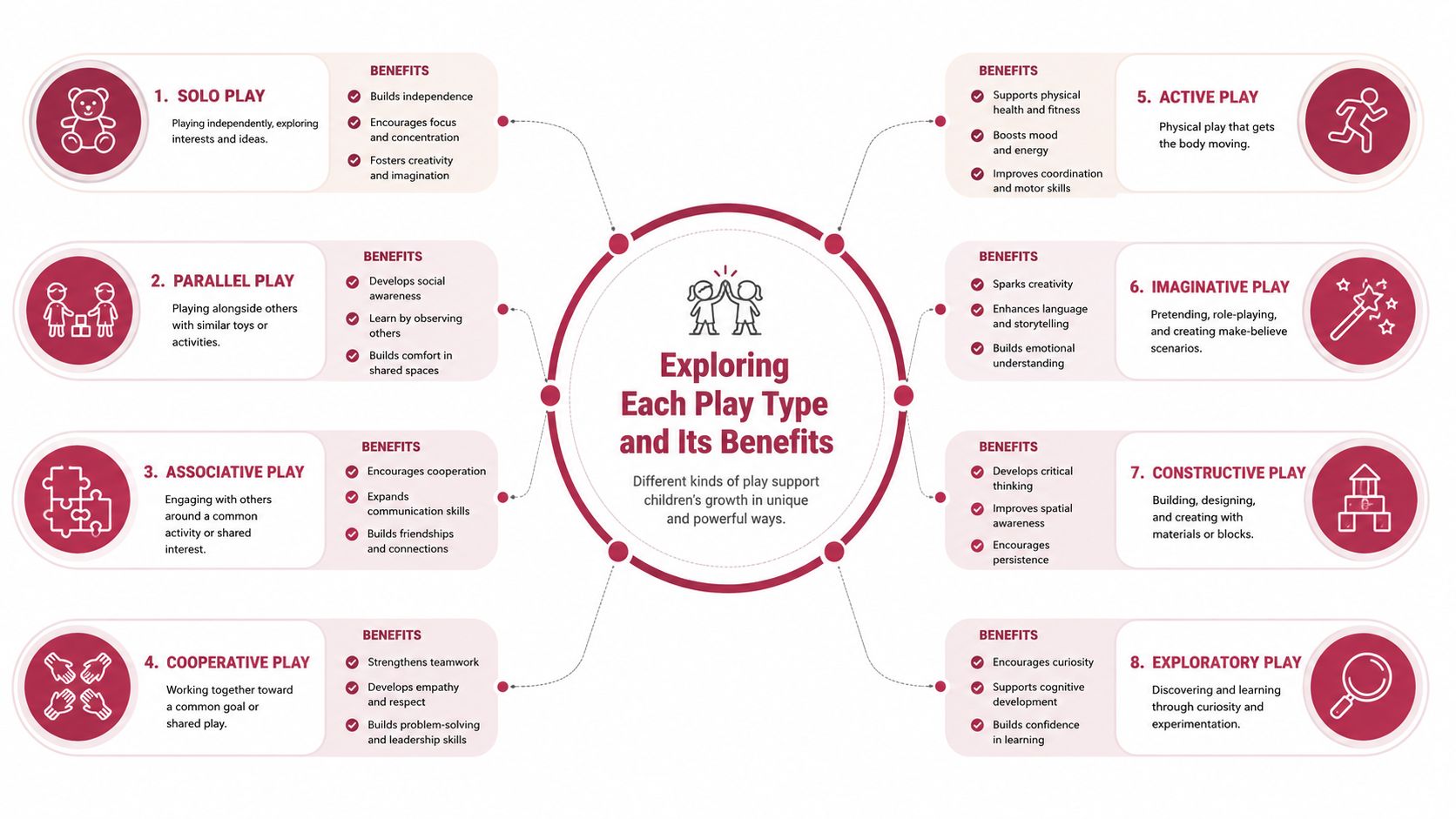
Sensory, exploratory, and object play
Exploratory play is what children do when they investigate how something feels, sounds, moves, or fits together. It can include touching textures, looking closely at leaves, pouring water, or mouthing safe objects when very young. This kind of play supports curiosity and early scientific thinking, because the child is learning through direct contact with the world (exploratory play overview).
Object play sits close to that. Children manipulate items to work out what they can do, and nursery staff often support it with blocks, cups, pegboards, and loose parts. The benefit is not just fine motor control. It also builds spatial reasoning and early problem-solving.
Constructive, creative, and symbolic play
Constructive play is what you see when a child builds a tower, makes a road, or creates a picture. It links hand skills with planning and persistence. Creative play and constructive play often overlap here, because children may also choose how a model should look or what materials should represent.
Symbolic play is where one thing stands for another. A spoon becomes a microphone, a scarf becomes a tail, a box becomes a car. That kind of thinking supports representational understanding, which is a key step in early learning. It also opens the door to storytelling and later literacy.
Children often show their richest ideas through pretend and make-believe, not through formal tasks.
Dramatic and role play are closely connected to symbolic play. A child may copy a parent, doctor, chef, or shopkeeper. In a shared pretend scene, that becomes socio-dramatic play, where children negotiate roles, language, and shared meaning together (play types overview).
Physical, locomotor, and social play
Locomotor play is movement play, running, jumping, climbing, skipping, and chasing. It supports gross motor development, balance, and spatial awareness. It also gives children a physical outlet for energy, which is one reason outdoor movement matters so much in early years practice. For more on that, see how outdoor play supports development.
Social play happens when children begin interacting more intentionally with others, sharing space, ideas, and goals. It may start with short exchanges and grow into more organised group play over time. In practice, children learn negotiation, empathy, and patience.
Preschool children don't use all these play types in equal amounts. Their interests shift with age, mood, confidence, and the materials available. A child who spends one week building almost constantly may move into pretend play the next. That movement is part of healthy development, not inconsistency.
Free Play Versus Guided Play
Parents often assume the choice is between letting children do whatever they want and teaching them directly. In reality, early years settings usually move between both. The difference matters, because each one supports learning in a different way.
What free play looks like
Free play is child-directed, spontaneous, and unstructured. A child decides what to use, how long to stay with it, and whether to change direction halfway through. That independence is valuable because it gives children room to follow curiosity without pressure.
Free play often looks simple. A child may line up animals, make a pretend meal, or spend ten minutes dropping stones into a bucket. Adults can be tempted to interrupt with questions or suggestions, but sometimes the best support is to watch carefully and leave the child in charge.
What guided play adds
Guided play keeps a learning goal in mind, but the adult shapes the experience lightly instead of taking it over. That might mean placing a few objects on a tray, asking one well-judged question, or adding a small prompt that nudges the child to notice something new. The child still explores, but the adult scaffolding makes the focus clearer.
The key difference is control. If adults over-direct, the activity can stop being play and become instruction. That can reduce the child-led exploration that supports creativity and curiosity (early learning guidance on free and guided play).
Why both matter in nursery life
A balanced nursery day usually includes both structured and unstructured play. The same guidance source defines structured play as adult-organised activity where the child follows directions or rules, and unstructured play as child-led free play where the child chooses what to play with and how to play (learning-through-play guidance).
That balance is important at home too. Some children need the security of a planned activity first, then the freedom to extend it. Others need open play first, then a gentle adult prompt to keep them engaged.
A clear way to think about it is this, free play builds independence, while guided play shapes attention. Children need both.
The Role of Risky Play in Child Development
Risk often makes adults tense, especially when a child is climbing, wrestling, or pushing into something that looks a bit uncertain. Yet in UK playwork, riskier play is not treated as something to eliminate completely. It is treated as something to manage well.
Why challenge matters
The UK play types model includes deep play and rough-and-tumble play as distinct forms. Deep play describes experiences that can feel life-threatening to a child and help them develop survival skills and conquer fear. Rough-and-tumble play focuses on testing strength through close physical contact such as tickling and wrestling (UK playwork model).
That doesn't mean children should be put in unsafe situations. It means controlled challenge has a role. When adults remove every test of balance, speed, or judgement, children lose opportunities to learn how their bodies and emotions work under pressure.
How adults can manage it well
A sensible approach is not “more risk” or “less risk”, but graded risk. The challenge should match the child's age, confidence, and setting. Supervision should be clear, but not so heavy-handed that the child cannot explore. The environment should invite movement while reducing avoidable danger.
Practical rule: children need enough challenge to feel stretched, not so much that they're overwhelmed.
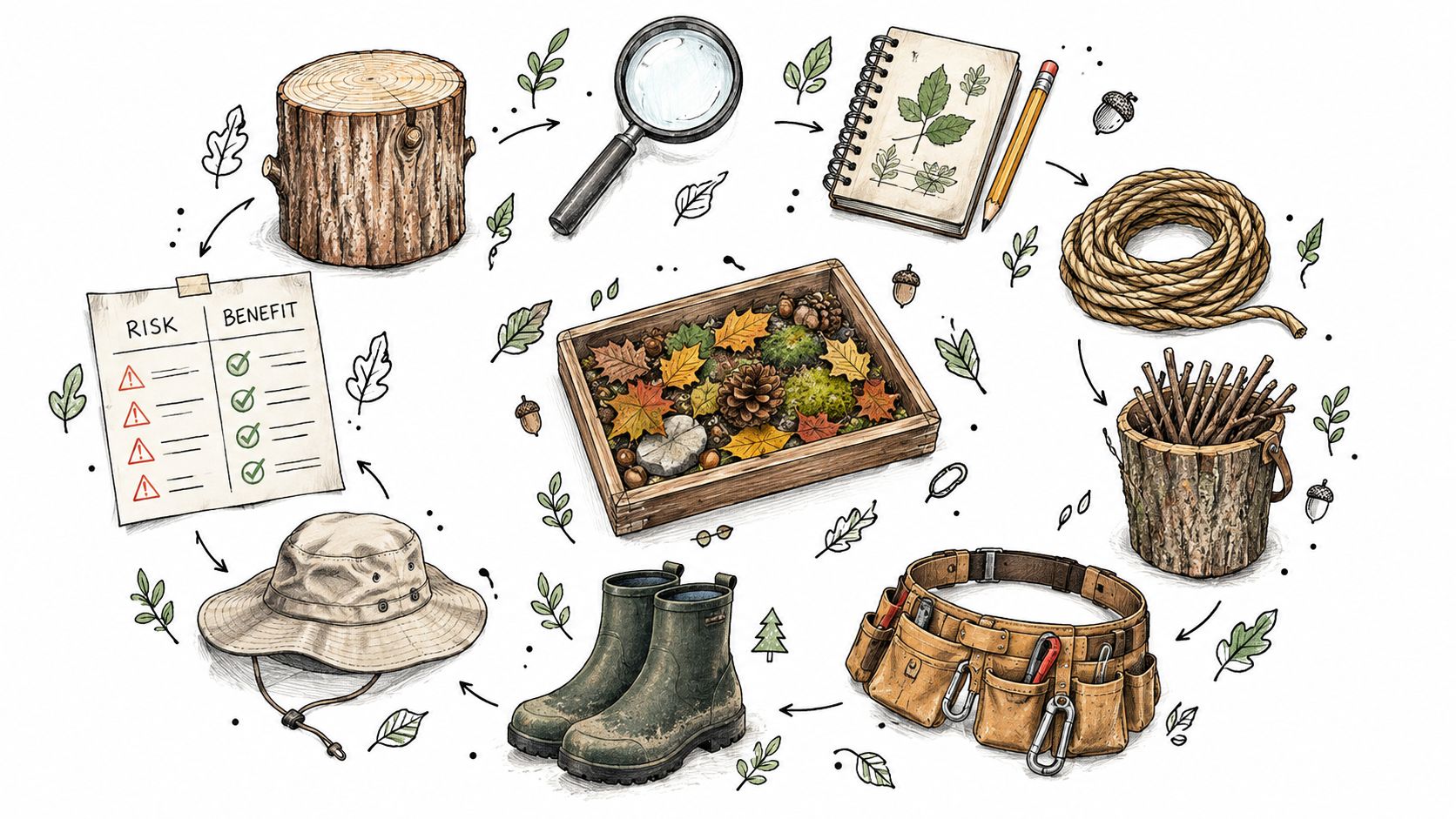
The distinction between hazard and risk matters. A hazard is something that can cause harm. A risk is the chance of harm happening in a particular situation. Early years settings can remove hazards without stripping away every opportunity for challenge. That's why outdoor learning often combines careful layout, watchful adults, and room for children to test themselves.
Parents who want more movement-based confidence building can also look at gross motor skills development to understand how climbing, balancing, and running fit into the bigger picture. The goal is not to make children fearless. It's to help them become safer, steadier, and more self-aware when things feel physically demanding.
How Social Play Develops Over Time
Children don't jump straight from solitary play to best-friend teamwork. Social play develops in steps, and those steps help adults understand what is age-appropriate. A child playing beside others, but not with them yet, is often exactly where they should be.
Parten's six stages
Mildred Parten's classic observations of children in nursery schools and playgrounds identified six stages of social play: unoccupied, solitary, onlooker, parallel, associative, and cooperative (social play stages). These are useful because they separate three non-social forms from three social forms.
- Unoccupied play is when a child is not yet engaged with toys or peers.
- Solitary play is independent play with no attempt to join others.
- Onlooker play is watching other children without joining in.
- Parallel play is playing beside others with similar materials.
- Associative play involves more interaction, but not yet a shared goal.
- Cooperative play means children work together with a common purpose.
What parents often misunderstand
Many parents worry when a child prefers to play alone or alongside others rather than with them. In early childhood, that can be entirely normal. A toddler may be fully absorbed in one activity while another child sits near them with matching toys. That's not failure to socialise. It's a developmental stage.
Parallel play is especially easy to miss because it looks quiet. Two children may each be building, sorting, or driving toy cars, while still noticing each other's presence. That proximity matters. It's often the bridge between independent play and true collaboration.
How this helps in daily life
Once children move towards associative and cooperative play, you'll usually see more negotiation, more language, and more disappointment when things don't go their way. That's not a sign that play has become harder for no reason. It's a sign that the social demands have increased.
Nursery staff use this understanding to avoid pushing children into group activity too early. They know some children need more watching, more beside-another-child time, or more simple shared materials before they're ready for a team game or a group story.
The main message is reassuring. Playing alone is not automatically a problem, and social play grows in its own time.
Supporting Different Play Types at Home and Nursery
You don't need a specialist setup to support rich play. Many of the best opportunities come from ordinary household items, a bit of space, and enough time for a child to stay with an idea. The key is not to stage every moment, but to notice what kind of play your child is drawn to and make that easier.
Small changes that make a big difference
For sensory and exploratory play, use safe everyday materials such as water, pasta, spoons, cups, fabric scraps, or cardboard boxes. For constructive play, keep blocks, stacking cups, recycled cartons, and simple building materials within reach. For pretend play, offer open-ended props like scarves, empty containers, toy food, or dress-up items that can become many things.
If your child enjoys movement, make room for it. A clear hallway, a garden, a local park, or simple indoor obstacle routes can support locomotor play without needing fancy equipment. The idea is to give children enough freedom to move, experiment, and repeat.
What to look for in a nursery
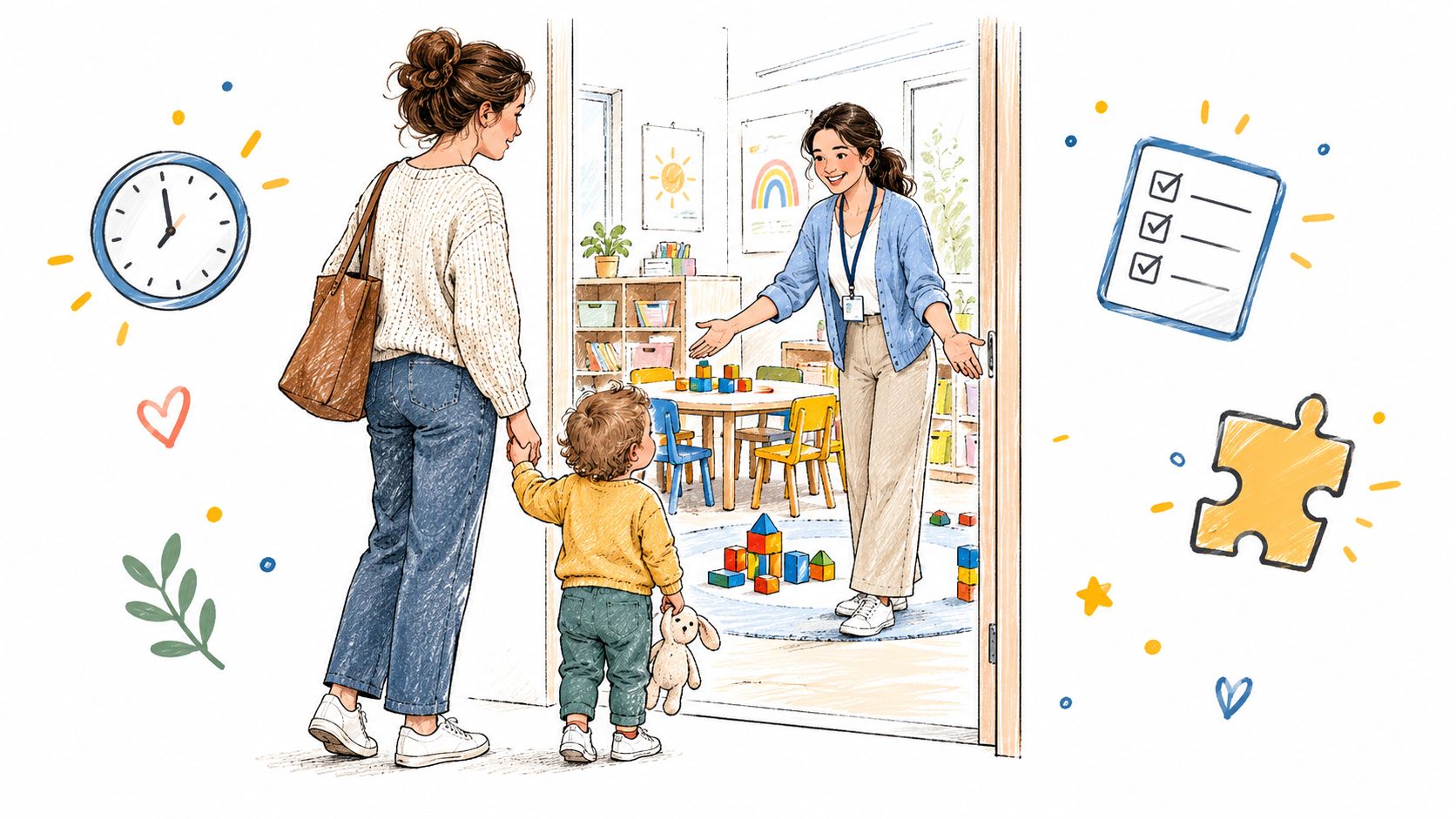
When you visit a nursery, ask how they support a range of types of play across the day. Look for signs that children have access to both structured and free choices, and that adults know when to join in and when to step back. A good setting usually offers materials for building, pretending, exploring, and moving, not just one kind of activity.
You might also ask how staff notice the difference between child-led play and guided moments. That question often tells you a lot about the quality of the environment and the confidence of the adults.
Useful question: “How do you support both child-led play and adult-guided activities across the day?”
If you'd like more practical ideas for play at home, nursery activity ideas can help you think about simple ways to extend learning without turning the day into a lesson plan.
One thing to remember
When you understand play types, ordinary moments make more sense. A child climbing, pretending, sorting, or playing beside a friend is not “just messing about”. They're building a set of skills that will keep developing for years.
If you're looking for a nursery that values play-based learning and gives children time for free play, guided activity, movement, and pretend play, Happy Tree Academy in Northwood offers early years care for children aged 3 months to 5 years. You can visit Happy Tree Academy to learn more and see how a play-rich day nursery can support your child's development.