When you hear ‘outdoor learning,’ what comes to mind? Muddy wellies and running free in the woods? You’re not wrong, but that’s just scratching the surface. The benefits of outdoor learning go so much deeper than just outdoor play; it’s a powerful educational philosophy that builds genuine resilience, confidence, and a real connection to nature.
What Is Outdoor Learning and Why Does It Matter?
Lots of parents picture outdoor learning as simply unstructured playtime outside. While there’s certainly plenty of fresh air and fun, it's actually a rich, thoughtful educational approach. Think of it as a long-term journey where children lead their own learning in a natural space, guided by a specially qualified practitioner.
It’s really a partnership between your child, their guide, and the great outdoors. Instead of an adult planning every minute, the practitioner observes what sparks the children's interest and helps them explore it. If a toddler is fascinated by a shiny beetle, that becomes an impromptu biology lesson. If a group of pre-schoolers decides to build a den, they’re actually learning about teamwork, physics, and problem-solving.
This unique way of learning is all about nurturing the whole child. It recognises that emotional wellbeing and social skills are just as crucial as remembering letters and numbers. The goal is to help your child grow in every way, not just academically.
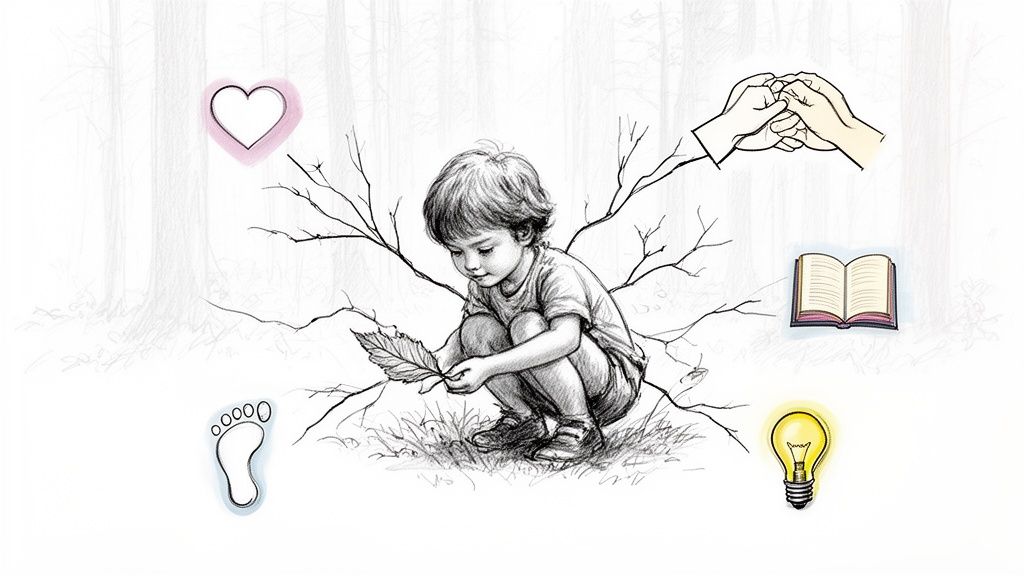
The diagram below really captures the essence of this philosophy. It shows how learning in nature nurtures the ‘head’ (thinking), the ‘heart’ (feeling), and the ‘hands’ (doing) all at once.
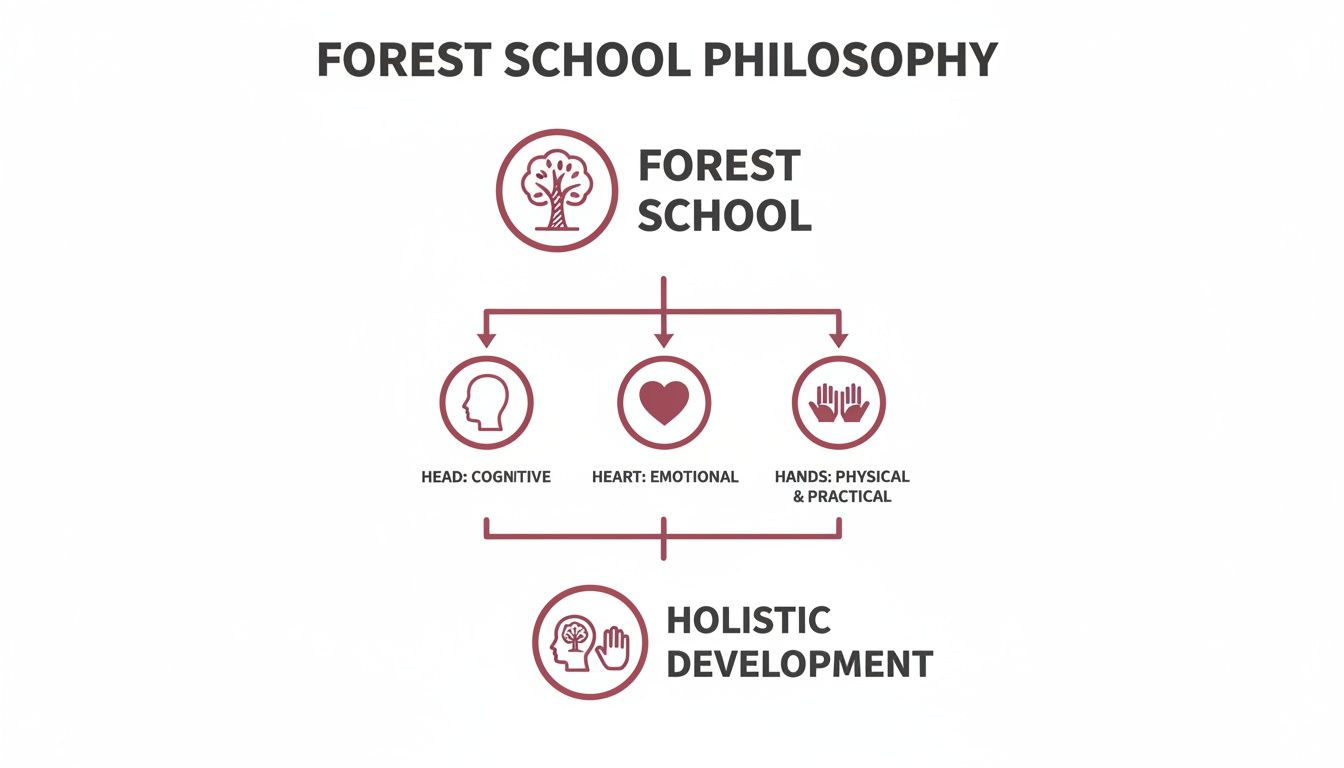
As you can see, it's about integrating thinking, feeling, and doing to support well-rounded, happy children.
The 6 Guiding Principles of Outdoor Learning
So, what makes it different from a simple walk in the park? Many outdoor learning approaches are built on six core principles. These aren't just guidelines; they are the commitments that make every session a meaningful experience.
To make these principles easy to digest, we’ve broken them down in the table below. It shows what each one looks like in practice and what it means for your child’s development.
Guiding Principles at a Glance
| Principle | What This Means for Your Child |
|---|---|
| A Long-Term Process | This isn’t a one-off trip. Sessions happen regularly, allowing your child to build a real relationship with the space, their friends, and their practitioner. |
| A Natural Setting | Learning happens in a woodland or natural environment. The sticks, leaves, and mud aren't just props; they are the learning resources. |
| A Learner-Centred Ethos | Your child's curiosity leads the way. Practitioners facilitate, rather than dictate, creating genuine excitement for discovery and learning. |
| Holistic Development | The focus is on the whole child—nurturing their social, emotional, and physical skills right alongside their intellectual ones. |
| Supported Risk-Taking | Your child will be encouraged to take small, manageable risks, like balancing on a log. This builds immense confidence. |
| Qualified Practitioners | Sessions are often led by trained professionals who understand both child development and how to keep children safe and inspired outdoors. |
By sticking to these six principles, early years settings create an environment that does more than just prepare children for school—it prepares them for life. It nurtures their character, fuels their curiosity, and gives them a strong foundation for all the adventures that lie ahead.
Building Confidence and Emotional Resilience
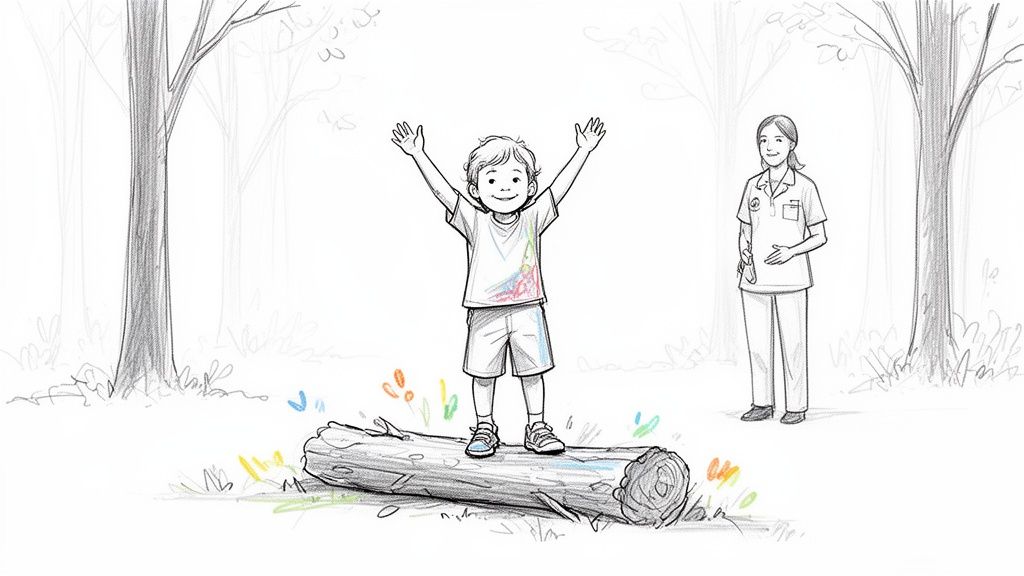
As an early years educator, one of the most incredible benefits of outdoor learning I see is the quiet, steady way a child’s confidence grows. Out in the woods, away from the four walls of a classroom, children learn to trust their own instincts and discover what they’re capable of in a way that’s hard to replicate anywhere else.
Imagine the feeling of accomplishment from successfully scrambling over a slippery log or working with a friend to drag a big branch. These small, child-led victories build on each other, creating a powerful inner voice that says, "I can do this." For a child who might be a bit timid in other settings, this feeling is a game-changer.
But it’s not just about physical feats; it's about emotional growth, too. The natural world itself has a wonderfully calming effect, and its rich sensory details can help children feel more grounded and less overwhelmed.
The great outdoors acts as a natural emotional co-regulator. The sheer space, the gentle sounds of the wind, and the feel of a rough piece of bark can soothe feelings of stress and anxiety. It gives children the headspace to process their feelings and build resilience in a truly supportive atmosphere.
This environment helps children learn to manage their big emotions. It’s a safe space where they can figure out how they feel without pressure or judgement, a skill that is absolutely vital for their happiness and future friendships.
Fostering Independence and Self-Esteem
In an outdoor learning setting, practitioners know when to step back. They give children the space to make their own choices, tackle their own problems, and take the lead. This approach is fundamental for building true independence.
Instead of being told what to do, a child decides for themselves how to build a shelter for a toy squirrel or which muddy path looks most interesting. This freedom gives them a real sense of ownership over their play and their learning.
Research backs this up time and time again. A key evaluation in England and Wales tracked young children over eight months and found a huge surge in their confidence. The study leaders observed that an astonishing 95% of positive changes in the children's self-esteem and independence came from the self-belief they gained in these natural spaces.
This boost in self-worth comes from genuine achievement. When a child finally masters a skill through their own persistence, the pride they feel is authentic and sticks with them.
Learning from Challenges and Building Resilience
A huge part of building confidence is learning to navigate challenges. The outdoors is full of natural, low-stakes obstacles that are perfect for teaching children about perseverance.
- Trying Again: A den built from sticks might collapse. A carefully stacked tower of pebbles might tumble over. These moments aren't failures; they’re valuable lessons that teach children it’s okay to have another go.
- Problem-Solving: Figuring out how to cross a puddle without soaking your wellies or how to tie a rope to a branch sparks creative thinking and determination.
- Emotional Regulation: Working through the small frustration of a failed attempt and choosing to try again is resilience in action. It teaches children that setbacks are just temporary hurdles to overcome.
This whole process helps children develop a 'growth mindset', where they see challenges as exciting opportunities to learn. If you're looking for ways to support your little one's emotional development, you might find our guide on how to help a child with separation anxiety at nursery helpful. The resilience they build splashing in puddles is a life skill that will see them through their school years and far beyond.
Developing Stronger Social and Communication Skills
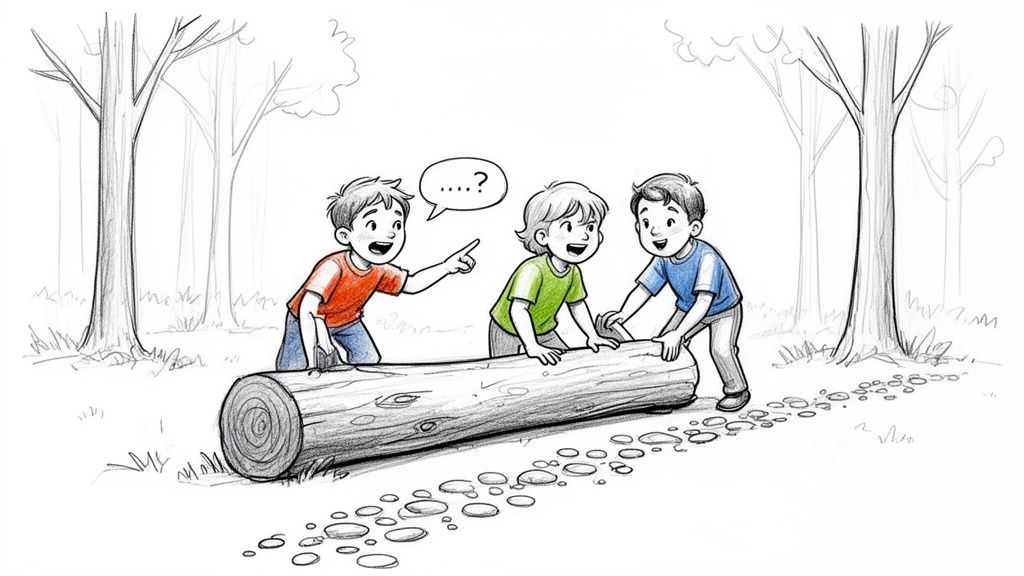
While helping a child grow in confidence is a wonderful achievement, one of the most powerful benefits of outdoor learning is watching them learn how to connect and get on with others. The great outdoors is a natural social playground, nudging children to communicate and cooperate in ways that are often harder to come by indoors.
Think about a typical playroom. It’s easy for squabbles to erupt over a single popular toy or a feeling of being crowded. In the woods, that pressure just melts away. There's endless space and a million things to discover, so children can choose to join a bustling group or find a quiet spot to themselves. This freedom naturally leads to a more relaxed, collaborative spirit.
These positive social bonds are the bedrock of healthy early development. We delve much deeper into this in our article exploring the power of play in nurturing young minds.
Fostering Natural Teamwork and Collaboration
Out in nature, teamwork isn't something that has to be orchestrated with adult-led games. It just happens. Children create their own challenges and, in turn, have to invent their own ways of working together to solve them.
Imagine a group of pre-schoolers deciding they want to build a bridge across a muddy patch. It’s a simple goal, but look at the complex social skills they put into practice without even realising it:
- Negotiating Roles: They naturally figure out who’s best at finding big sticks and who’s good at placing them. They learn to delegate and value what each friend brings to the task.
- Sharing Ideas: One child might suggest a long log, but another thinks flat stones would work better. They have to listen, debate, and come to a group decision.
- Working Towards a Shared Goal: Shifting a heavy branch or gathering enough leaves for a den is often too big a job for one person. They quickly learn that by pulling together, they can achieve something amazing and celebrate that success as a team.
The real magic here is that the motivation comes from within. They aren't working together because a grown-up told them to; they're doing it because they really want that bridge to exist. This makes the social skills they learn far more meaningful and likely to stick.
Developing Communication and Empathy
Beyond just getting a job done, the discoveries and small challenges of the outdoors open up countless chances for children to build more nuanced communication skills. They learn to voice their ideas, listen to what others think, and develop true empathy.
When a child sees their friend struggling to climb over a log, their instinct is often to offer a hand or shout words of encouragement. This is empathy in action—recognising another’s difficulty and wanting to help. The outdoor world is full of these small moments that teach children to be aware of and responsive to the needs of others.
This kind of environment can be a huge relief for children who are a bit more reserved. Having a shared focus—like watching a fascinating beetle or working together on a shelter—gives them a natural, low-pressure way to start a conversation. It provides something to talk about, which can feel much safer and easier than direct, face-to-face socialising.
By navigating these rich social landscapes, children are practising the very skills they’ll need to start school, make new friends, and build happy relationships throughout their lives. They’re learning how to be part of a community where everyone has a valuable part to play.
Enhancing Physical Health and Motor Skills
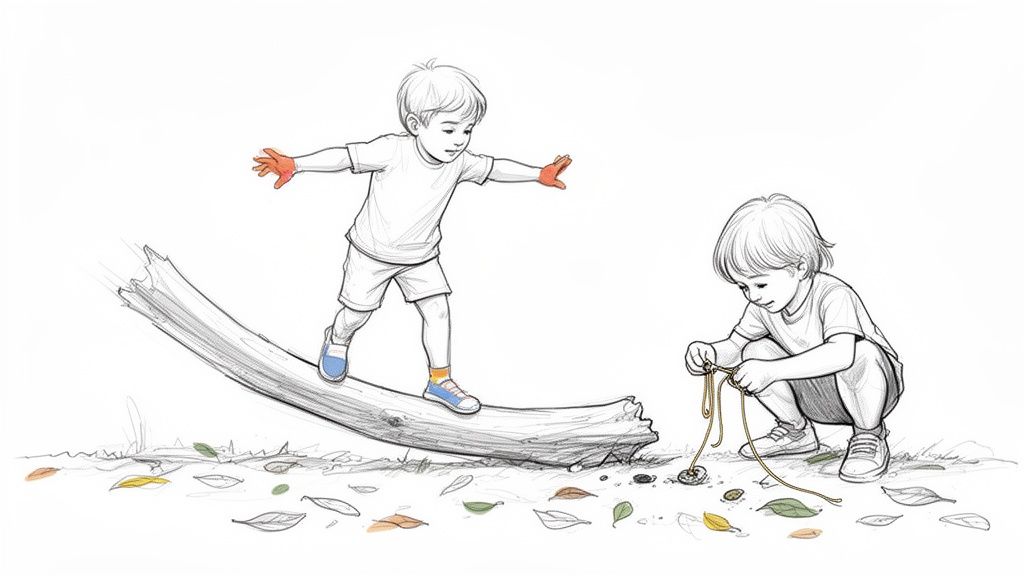
It’s one of the first things you notice about children who spend lots of time outdoors: how they move. There's a confidence and capability in their physical actions that speaks volumes. We all know fresh air and running around are good for them, but the dynamic, ever-changing natural world offers a full-body workout that no flat, predictable playground can ever hope to match.
Think about a child navigating a woodland path versus running across a perfectly smooth, tarmacked surface. In the woods, no two steps are the same. They are constantly adjusting their balance to scramble over a fallen log, judging their footing on uneven ground, and weaving around trees. This isn't just movement for movement's sake; it’s a constant, rich conversation between their body and the world around them.
This non-stop adaptation is brilliant for developing their gross motor skills. Balancing along a log isn't just a game—it builds incredible core strength and focus. Climbing up a gentle, mossy bank strengthens their arms and legs. Each action helps to sharpen a child's coordination and their proprioception, which is that amazing internal sense of where their body is in space.
In an outdoor setting, exercise isn't a chore; it's a natural consequence of curiosity. When a child is determined to see what’s on the other side of a log pile, they are engaging in a complex physical challenge that is far more engaging and effective than any structured exercise routine.
The best part is, the children have no idea they're doing 'exercise'. They are simply playing, exploring, and satisfying their own curiosity, which helps them build a genuinely positive and lasting attitude towards being active.
Developing Fine Motor Skills Through Nature
While all that running, climbing, and balancing works the large muscle groups, outdoor learning is also fantastic for honing the small, precise movements we call fine motor skills. These are the skills that will eventually help your child hold a pencil correctly, do up their own coat, and use a knife and fork.
Instead of sitting at a table with structured tasks, children get to practise these skills in a much more natural and engaging way:
- Handling Small Objects: Picking up tiny seeds, delicate petals, or smooth, cool pebbles is perfect practice for their pincer grasp—the crucial ability to hold something between thumb and forefinger.
- Manipulating Materials: Moulding natural clay, weaving long blades of grass, or trying to tie a knot with a piece of twine all demand dexterity and hand-eye coordination.
- Creative Construction: Building a tiny shelter for a beetle out of twigs and leaves involves careful placement and precise control, strengthening all the small muscles in their hands and fingers.
These hands-on, sensory-rich activities are just so much more compelling for a young child, and they brilliantly prepare them for the more formal classroom tasks they’ll encounter later on.
Boosting Overall Health and Wellbeing
Beyond just muscle development, spending regular time in nature has a profound impact on a child's overall health. This active, play-based approach helps children become more physically robust, from building stamina to supporting a healthy immune system.
Research consistently shows that children are simply more active when they learn outdoors. One major evaluation in England discovered that children achieved far higher levels of physical activity on their outdoor learning days, often easily exceeding the recommended 60 minutes of daily activity.
This increased movement doesn't just build a strong, healthy body. It’s also directly linked to better mental wellbeing, including improved moods and greater self-esteem. As parents, it's wonderful to know that these outdoor adventures are nurturing a child who is not only physically capable but also happy, confident, and resilient. To learn more about this, you can read our guide on how important outdoor play is and what its benefits are.
Sparking Curiosity and Preparing for School
How does splashing in a muddy puddle or collecting sticks actually prepare a child for a primary school classroom? It’s a question parents often ask, and the answer gets to the very heart of early years education. The link between outdoor play and school readiness is surprisingly direct, building the essential thinking skills and curiosity your child needs to thrive.
Think of the outdoors as the ultimate, hands-on learning lab. You can talk about the seasons in a classroom, but feeling the first crisp autumn air on your cheeks or hearing the crunch of frosty leaves under your wellies makes that lesson unforgettable. Discovering a wiggly worm or watching a spider carefully spin its web is what truly sparks a child’s mind, leading to a cascade of questions—"Where does it live?", "What does it eat?", "Why is it doing that?".
This isn't just random play; it's the very beginning of scientific thinking. These real, tangible experiences lay a strong foundation for understanding more complex ideas down the road.
From Playful Discovery to Classroom Skills
The skills children pick up while exploring the woods have a direct, positive impact on their ability to learn in a more formal setting. The intense concentration it takes to balance along a fallen log is the very same focus they’ll need to sit and listen to a story. The creative problem-solving they use to figure out how to build a den is the same critical thinking they'll one day apply to a tricky maths puzzle.
In a playful, low-pressure way, these experiences build crucial pre-academic skills:
- Early Maths Concepts: Instead of drilling times tables, children might be counting pebbles, sorting leaves by shape and colour, and noticing patterns in a snail’s shell. They learn about size, shape, and quantity in a way that makes sense to them.
- Language and Storytelling: A day’s adventure naturally turns into a story to share. Describing what they saw, heard, and felt expands their vocabulary and teaches them how to build a narrative from beginning to end.
- Scientific Investigation: Following a trail of ants or watching how rainwater flows downhill are genuine science lessons. Children learn to observe, ask questions, and test out their own ideas.
Building Focus and Self-Regulation for the Classroom
One of the most powerful links between an outdoor approach and school readiness is the development of self-regulation. This is your child’s ability to manage their emotions and behaviour, focus their attention, and stick with a task—all absolutely vital for learning. The calm, open-ended nature of the outdoors helps children build this muscle naturally.
The ability to self-regulate is a strong predictor of academic success. Time in nature gives children the space to practise focus without the overstimulation of a busy indoor environment, building their capacity for concentration in a way that feels like play.
This isn't just a gut feeling; the research backs it up time and again. A landmark three-year UK study that followed children in outdoor learning programmes found profound benefits. The children showed remarkable improvements in their schoolwork across all subjects, achieving results well beyond what was normally expected for their age. The researchers pointed directly to the enhanced self-regulation and resilience these children gained from their time outdoors. You can read more about these findings and their implications for early education.
By nurturing their natural curiosity and strengthening their ability to focus, early years settings help children arrive at school not just ready to learn, but genuinely excited to find out what comes next.
Supporting Outdoor Learning Beyond Nursery
The magic of outdoor learning doesn’t have to end when you pick your child up from nursery. In fact, bringing that same sense of curiosity and adventure into your family life is one of the best ways to deepen the benefits and build wonderful memories together.
It's not about recreating specific activities. It’s much simpler than that. It’s about shifting your mindset and embracing a shared sense of wonder in the world around you.
When you follow your child’s lead and get excited about what excites them—whether it’s a funny-shaped leaf or a wiggly worm—you’re sending a powerful message: their discoveries matter. That shift can turn a simple walk in the park into a grand expedition, nurturing a love for nature that can last a lifetime.
Simple Ideas for Family Nature Adventures
You really don’t need any special kit or a trip to a remote forest. Curiosity can be sparked right in your back garden or at the local park. The goal is simply to notice the world, together.
Here are a few easy, low-cost ideas for families:
- Go on a 'Listening Walk': Find a quiet bench and close your eyes for a minute. Just listen. What can you hear? The rustle of leaves, a distant siren, a dog barking, birdsong? Chat about the different sounds and how they made you feel.
- Create a 'Treasure Box': An old egg carton or a small cloth bag is perfect for this. Let your child collect natural ‘treasures’ on a walk – smooth pebbles, fallen petals, crinkly leaves, interesting twigs. The act of choosing makes each item special.
- Watch the Clouds: On a clear day, lie on a blanket in the garden and just watch the clouds drift by. It’s a beautifully calming activity. What shapes can you see? Can you spot a dragon, a ship, or a fluffy sheep?
These shared moments are more than just fun. They reinforce that learning is a joyful adventure, strengthening your family bond while quietly supporting your child's development.
Deepening Their Thinking with Open-Ended Questions
One of the most powerful tools used in early years is the open-ended question, and it's something you can easily adopt at home. The trick is to avoid questions that have a simple 'yes' or 'no' answer.
An open-ended question is a little invitation for your child to think more deeply. Instead of asking, "Is the ground wet?" which ends the conversation, try asking, "I wonder what the ground feels like today?" or "What do you notice about the leaves on this path?". It encourages them to observe, analyse, and share their unique perspective.
This style of questioning is fantastic for building critical thinking and communication skills. It shows your child you’re genuinely curious about their thoughts and ideas, not just testing their knowledge.
This supportive, child-led approach is one of the core forest school benefits championed by many early years settings. If you're looking for a nursery in the Northwood area that embraces outdoor learning, we’d love to show you around. Seeing it in action is the best way to understand its impact, so feel free to book a tour and come see for yourself.
Frequently Asked Questions About Outdoor Learning
As the idea of your child spending their days outdoors captures your imagination, it’s completely natural for a few questions to pop up. We often chat with parents who are curious about the practical side of things – from safety to the wonderfully unpredictable British weather.
So, let's walk through some of the most common queries. We want you to feel completely confident and excited about what outdoor learning can offer.
Is It Safe?
This is usually the very first question parents ask, and it’s the most important one. The short answer is, absolutely. Safety isn't just a box to tick; it's woven into the very fabric of how a quality outdoor learning programme operates. Every session is guided by a practitioner with training in outdoor first aid and, crucially, in dynamic risk assessment.
But here’s the key difference: instead of trying to wrap children in cotton wool and eliminate every single risk, children are taught how to navigate their world safely. Think about a child wanting to climb a fallen log. Rather than a flat 'no', a practitioner might show them how to check if it’s wobbly, how to find good handholds, and how to climb down carefully. It’s about empowering children to make smart choices for themselves, a skill that will serve them for life.
What Happens When the Weather Is Bad?
Many settings fully embrace the well-known saying: there’s no such thing as bad weather, just the wrong clothing! Sessions are designed to run all year round, giving children a front-row seat to the magic of the changing seasons.
Seeing the environment change with the seasons is a key part of the learning experience. Splashing in puddles after a downpour or noticing how frost sparkles on leaves are valuable sensory discoveries that wouldn't happen on a sunny day.
Of course, the children's wellbeing is always the top priority. In the rare event of extreme weather like gale-force winds or a thunderstorm, nurseries have contingency plans to use a sheltered space or an indoor area. The right waterproofs and warm layers are the real secret to ensuring everyone stays happy and comfortable, whatever the sky is doing.
Will My Child Get Dirty?
Oh, yes! And many educators wouldn't have it any other way. A bit of mud on the knees or dirt under the fingernails is a sign of a brilliant day. It shows your child has been truly lost in their play and exploration.
Getting messy is part of the joy. It means they’ve been fully immersed in the experience, whether that’s concocting a magical ‘potion’ in the mud kitchen, digging for wriggly worms, or feeling the grass on their back as they roll down a hill. So, the best advice is to dress them in clothes that are ready for an adventure.