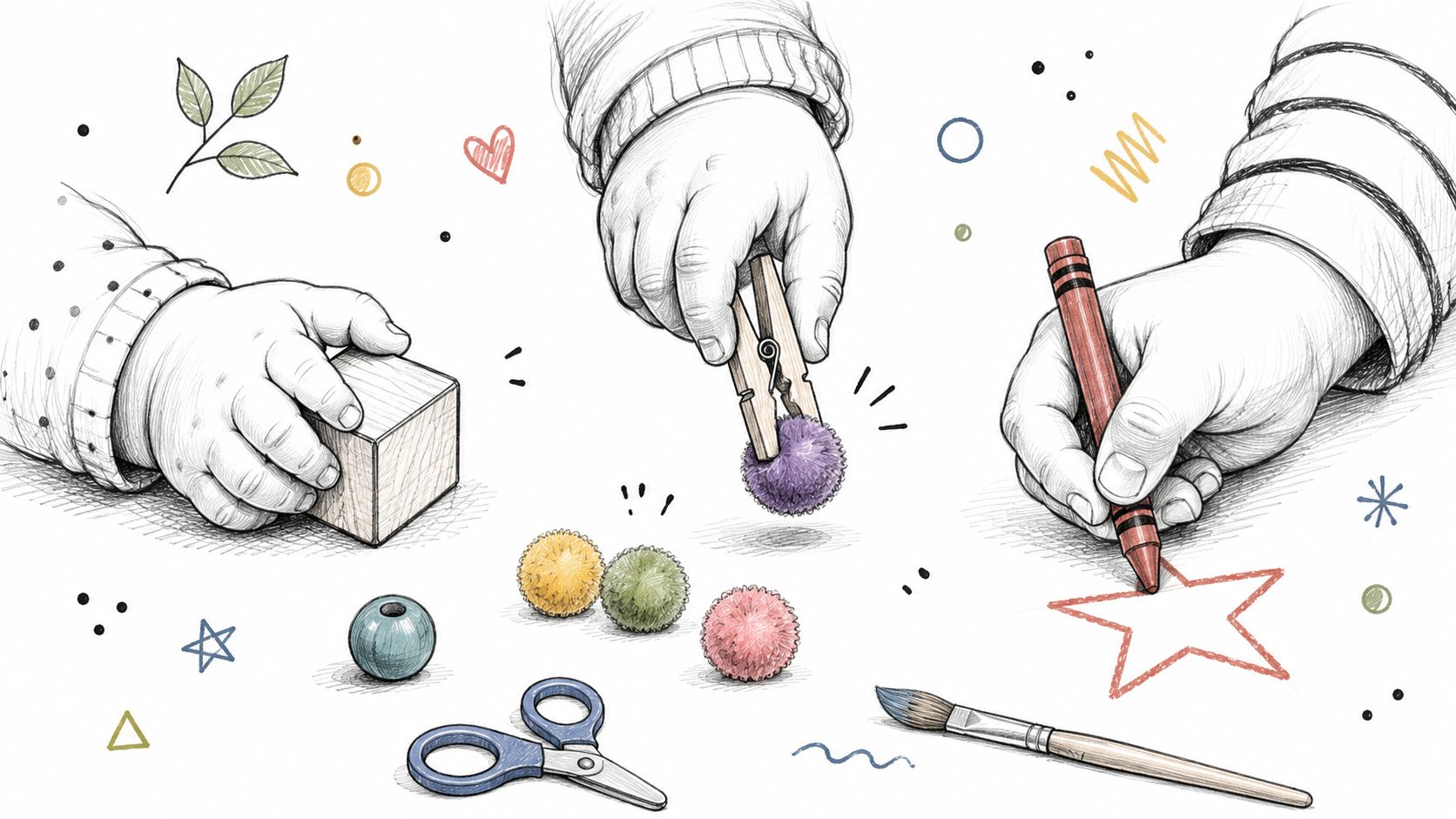

A pea rolls across the highchair tray. Your baby tries to pinch it, misses, tries again, then finally gets it between finger and thumb with a look of fierce concentration. Later, your toddler grips a chunky crayon in a whole fist and makes determined circles on the paper. These tiny moments can look simple, but they're doing a lot of developmental work.
Those small, careful movements are part of fine motor skills development. They involve the hands, fingers and wrists working together with the eyes and the rest of the body. They help children hold a spoon, turn pages, stack blocks, use scissors, fasten buttons and, eventually, write.
If you've ever wondered what's typical, what helps, and when to ask for support, you're not alone. Many parents feel unsure because fine motor skills grow gradually, often in little bursts. A child may struggle with one task for weeks, then suddenly manage it with ease.
A Warm Welcome to the World of Little Hands
Fine motor skills can sound technical, but the idea is simple. They're the small movements children use to do precise jobs with their hands and fingers.
You'll see them in everyday life. A baby reaching for a rattle. A toddler trying to use a spoon without tipping everything onto the floor. A preschooler carefully peeling a sticker or turning the pages of a favourite book. None of this happens all at once. It builds slowly, through play, repetition and growing body control.
What often confuses parents is that hand skills don't start in the hands alone. They begin with the whole body. A child needs stability in their shoulders, trunk and posture before their fingers can do finer, more detailed work well. That's why activities that look unrelated, such as tummy time, climbing, crawling and floor play, matter so much.
Fine motor progress rarely looks neat or perfectly timed. It usually looks like practice, mess, retrying and small wins.
You don't need expensive toys or a complicated plan. Most children build these skills through ordinary routines, playful repetition and chances to explore safely with their hands.
What Are Fine Motor Skills and Why They Matter
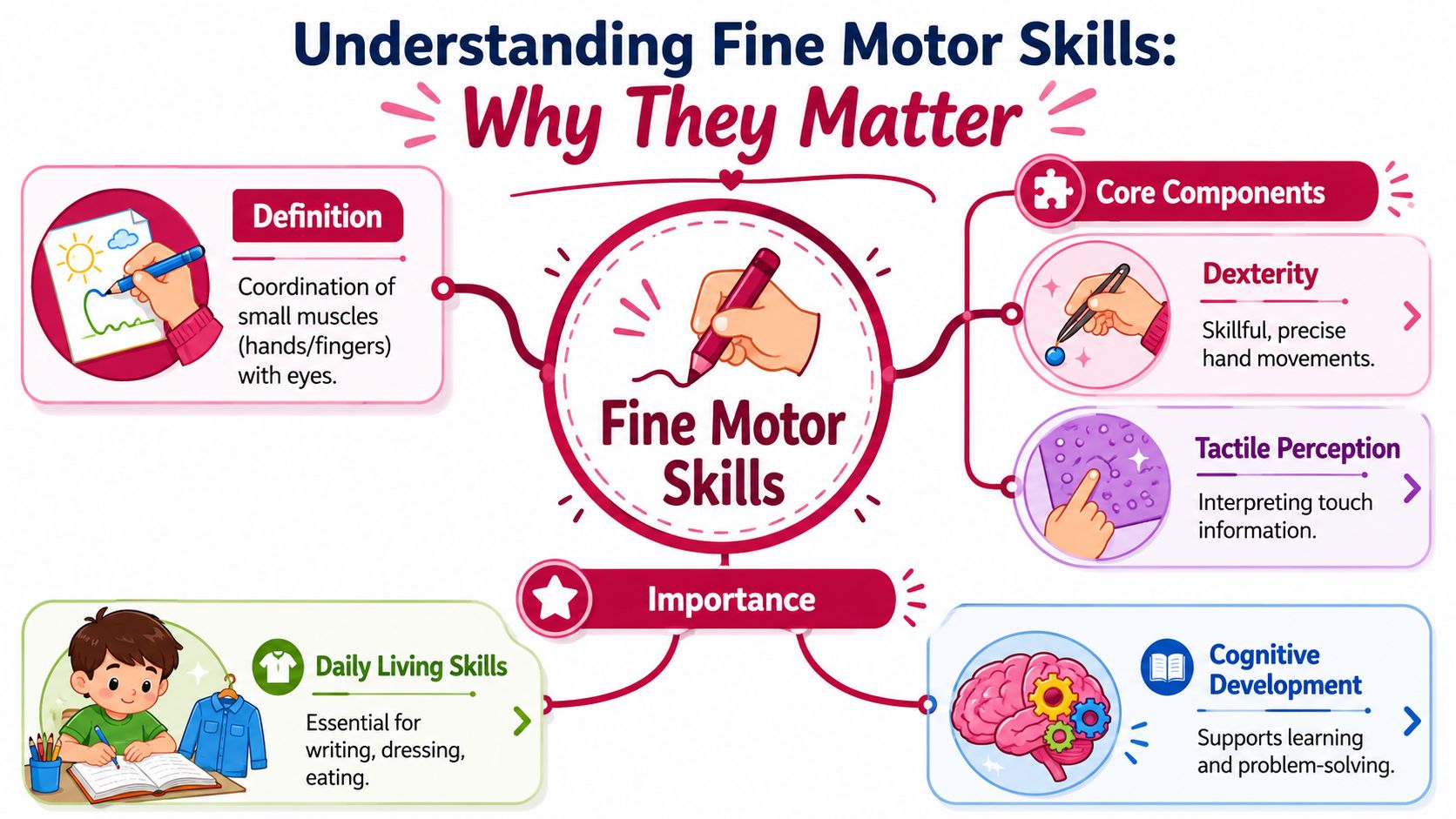
Fine motor skills are the movements that let children use the small muscles of the hands and fingers with control. They're what make it possible to pick up a raisin, hold a paintbrush, do up a zip or guide a pencil across a page.
The main building blocks
Fine motor development rests on several underlying skills. The Down Syndrome Resource Foundation guide to fine motor development explains that the building blocks are tactile perception, postural control, bilateral coordination and dexterity.
Here's what that means in everyday terms:
- Tactile perception helps a child understand what they're touching. That's important when they explore textures, hold food, or judge how much pressure to use.
- Postural control gives the body a steady base. If a child is wobbling at the table, it's much harder to use their hands precisely.
- Bilateral coordination means using both hands together. One hand might hold the paper while the other draws, or one hand steadies a bowl while the other stirs.
- Dexterity is the skill of making small, accurate hand movements.
Think of it like building a house
Gross motor skills are the strong frame and foundations. They include rolling, sitting, crawling, standing and balancing.
Fine motor skills are the detailed work inside the house. They're the wiring, handles, switches and finishing touches that make everything function smoothly. If the frame isn't steady, the detailed work becomes much harder.
That's one reason outdoor movement and active play matter so much. If you'd like a broader look at that connection, this guide to the benefits of outdoor learning in early years gives helpful context.
Why these skills matter every day
Fine motor skills support much more than drawing. They affect:
| Everyday area | Fine motor examples |
|---|---|
| Self-care | using a spoon, pulling up socks, buttoning, brushing teeth |
| Play | building with blocks, threading, puzzles, stickers |
| Creativity | painting, mark making, cutting, modelling dough |
| Early learning | turning pages, using tools, beginning writing movements |
When children can manage these small tasks, they often feel more capable. That growing sense of “I can do it” feeds confidence, independence and willingness to try new things.
Fine Motor Milestones From Birth to Five Years
Milestones are best seen as a guide, not a test. Children don't all follow the same pattern, and a skill may appear in one setting before another. A child might manage a spoon at nursery but refuse it at home, or snip paper one day and avoid scissors the next.
Even so, broad age patterns can be reassuring. They help you see how fine motor skills usually build from early grasping to more controlled tool use.
Babies from birth to 12 months
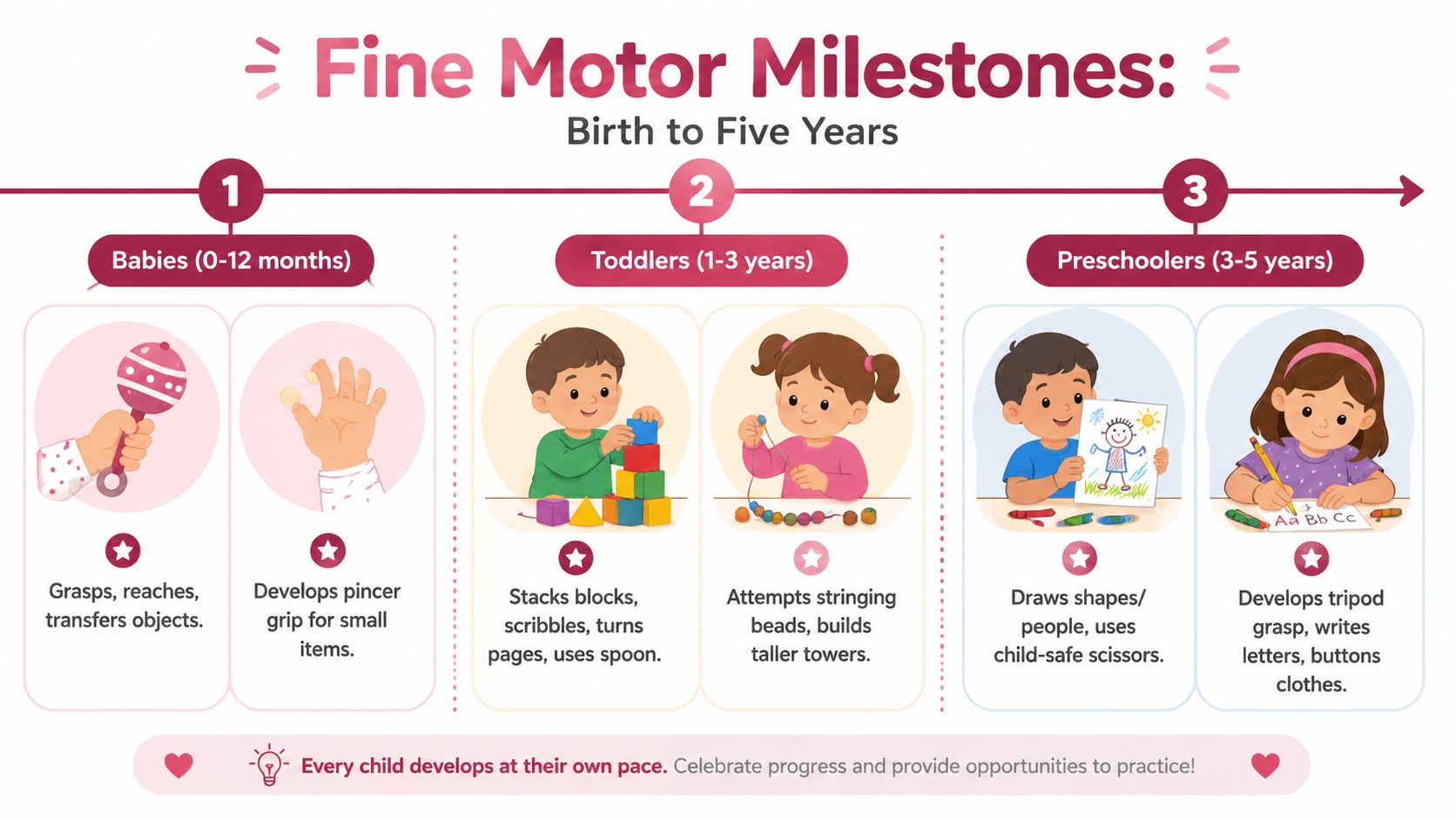
In the earliest months, babies are learning to bring their hands together, open and close their fingers, and reach towards objects. These early movements are closely tied to body strength.
Tummy time matters here. The prompt research used for this article notes that in the UK, the EYFS framework expects children by 30 months to show emerging fine motor control by holding a pencil in a static tripod grip and making purposeful marks, and that babies who have 45 minutes of daily tummy time before 6 months show a 35% higher rate of static tripod grasp acquisition at 18 months in the same prompt research source. I've linked that only here, where it's most relevant, alongside this overview of what the EYFS framework is.
A separate milestone guide from Brown University Health on children's development says that by two months, babies should be able to lift their head during tummy time and push up onto their forearms, while also closing their fingers in a tight grasp and briefly holding a rattle with one hand.
Another helpful explanation from Children's Hospital of Richmond on tummy time and fine motor foundations highlights how prone play strengthens the head, neck, shoulders, wrists and hands. That stability supports later hand control.
Typical baby progress often looks like this:
- Early months
brief grasping, swiping at toys, bringing hands to mouth - Middle of the first year
reaching more deliberately, holding toys, passing an item from one hand to the other - Later in the first year
using finger and thumb more precisely, pointing, poking and picking up smaller items
Practical rule: If you want better hand use later, start with safe floor play now.
Toddlers from 1 to 3 years
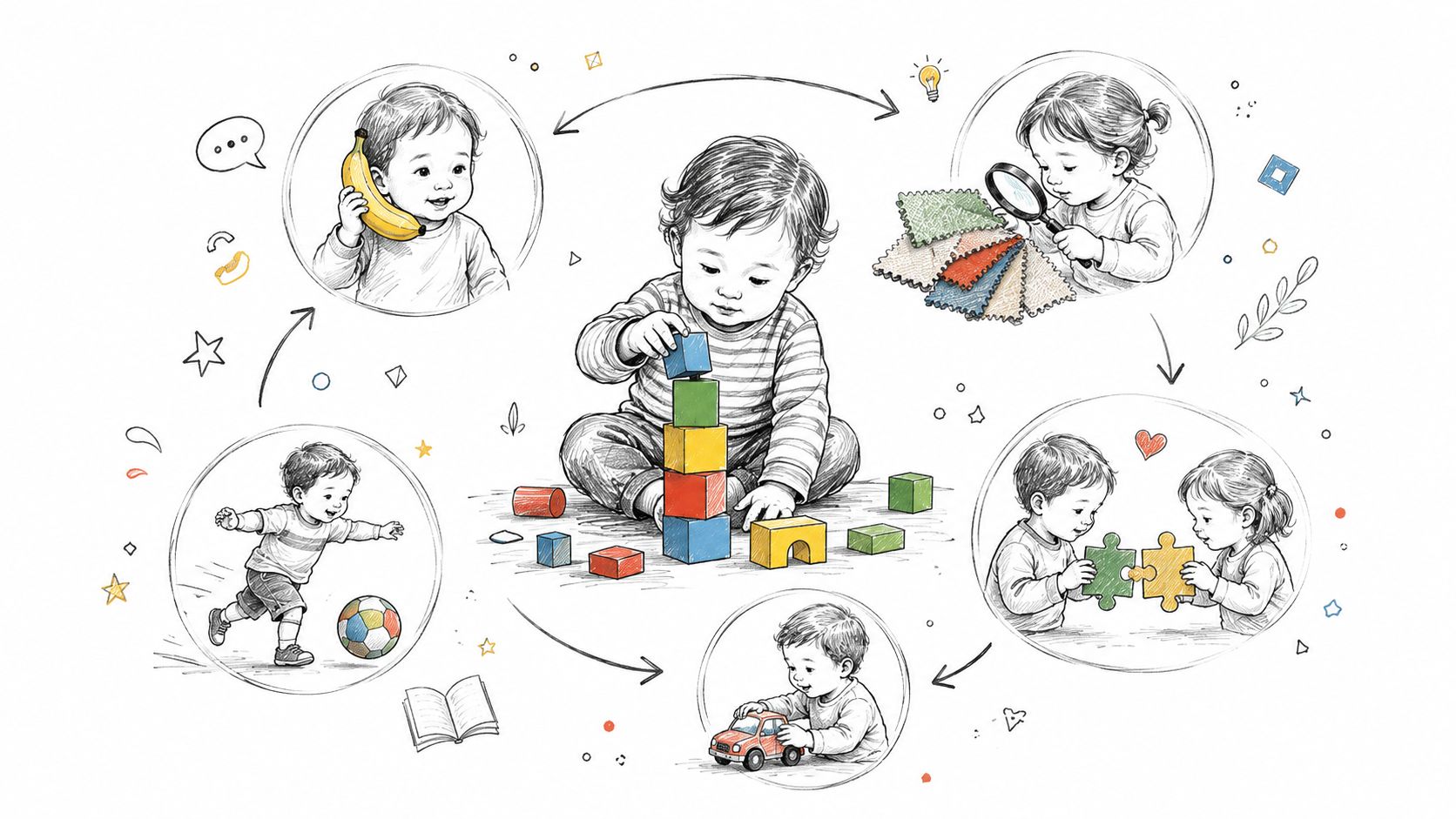
Toddlers are busy practising control through repetition. They love filling and emptying, posting objects, stacking, dropping, squashing and carrying. That's not random. It's hand training.
At this stage you might notice your child:
- scribbling with chunky crayons
- turning thick book pages
- using a spoon, even if it's messy
- stacking blocks
- trying simple shape sorters
- beginning to pull apart and fit together toys
Grip changes slowly too. Many toddlers still use a whole-hand grasp on crayons before moving towards more refined finger control.
Preschoolers from 3 to 5 years
By the preschool years, many children are ready for more accurate hand work. According to NAPA Centre's guide to fine motor examples, three-year-olds typically achieve the ability to snip with scissors, manipulate simple puzzles and string large beads.
As children move through this stage, you may see them:
| Age range | Common fine motor signs |
|---|---|
| Around 3 years | snipping paper, stacking higher towers, opening containers, drawing simple lines |
| Around 4 years | using tools with more control, drawing clearer shapes, managing some clothing fasteners |
| Around 5 years | stronger pencil control, copying simple forms, greater independence with dressing and craft tasks |
The UK early years picture adds useful context. The 2023 EYFS progress check data showed that 41% of 5-year-olds in England had not yet achieved the expected level of pencil control for writing, with 18% of those children requiring additional support in Reception Year. The same verified data notes that in settings using a joined-up physical development approach, 78% of children met fine motor milestones by age 4, compared with a national average of 62%.
That's a reminder to stay calm and keep perspective. Some children need more time, more practice, or more support. That doesn't mean anything has gone wrong.
Everyday Activities to Boost Fine Motor Skills
Parents often think they need specialist toys for fine motor practice. Usually, they don't. The best activities are often the ones already built into your day.
The prompt research behind this topic notes that 42% of UK parents report using household items like clothespins for fine motor practice due to cost pressures. That makes sense. Children don't care whether the challenge comes from a branded resource or a washing basket and a few pegs.
For more playful ideas alongside the ones below, you might also like these creative activities for toddlers.
In the kitchen
The kitchen is full of natural hand-work.
- Tear and sprinkle herbs into a bowl. This strengthens finger isolation and control.
- Stir thick mixtures such as porridge oats with yoghurt. Resistance helps build wrist and hand strength.
- Peel easy foods like banana strips or satsuma segments.
- Transfer items such as pasta shapes from one bowl to another using fingers, a spoon or child-safe tongs.
- Press and poke dough with fingertips if you're baking.
If your child gets frustrated, make the job smaller. Two pasta shells are enough. One good stir is enough.
In the utility room or with household chores
Ordinary chores can be brilliant for fine motor skills development because they feel purposeful.
The clothes peg idea that really works
Folding laundry offers more hand practice than is generally apparent. Children can match socks, pull flannels apart, squeeze pegs and clip light clothing to a low airer.
Many children try harder when a task feels real. Pegging Dad's sock to the rack can be more motivating than a worksheet.
Quick activity template
The Clothes Peg Challenge
You need: a few clothes pegs, a small tub or cardboard box, pom-poms or rolled socks
What to do:
- Put the pom-poms or socks on the table.
- Show your child how to squeeze the peg open.
- Ask them to pick up one item at a time and drop it into the tub.
- For older children, sort by colour or size.
Skills practised: hand strength, pincer grip, bilateral coordination, hand-eye coordination
In the garden or outdoors
Natural materials are excellent because they vary in size, texture and resistance.
Try:
- Collecting petals or leaves and dropping them into a pot
- Scooping soil or sand with a small trowel
- Picking up pebbles and placing them in muffin cases
- Pulling up grass or weeds with supervision
- Using a spray bottle to water plants
Outdoor tasks often work well for children who resist table activities. They don't feel like practice. They feel like exploring.
In the creative corner
Creative play gives children repeated chances to squeeze, pinch, roll, press and control tools.
Simple favourites that do a lot
- Playdough or home-made dough for rolling balls, making snakes, poking holes and hiding beads in the dough
- Stickers for peeling and placing
- Chunky crayons and chalk for large marks before smaller drawing
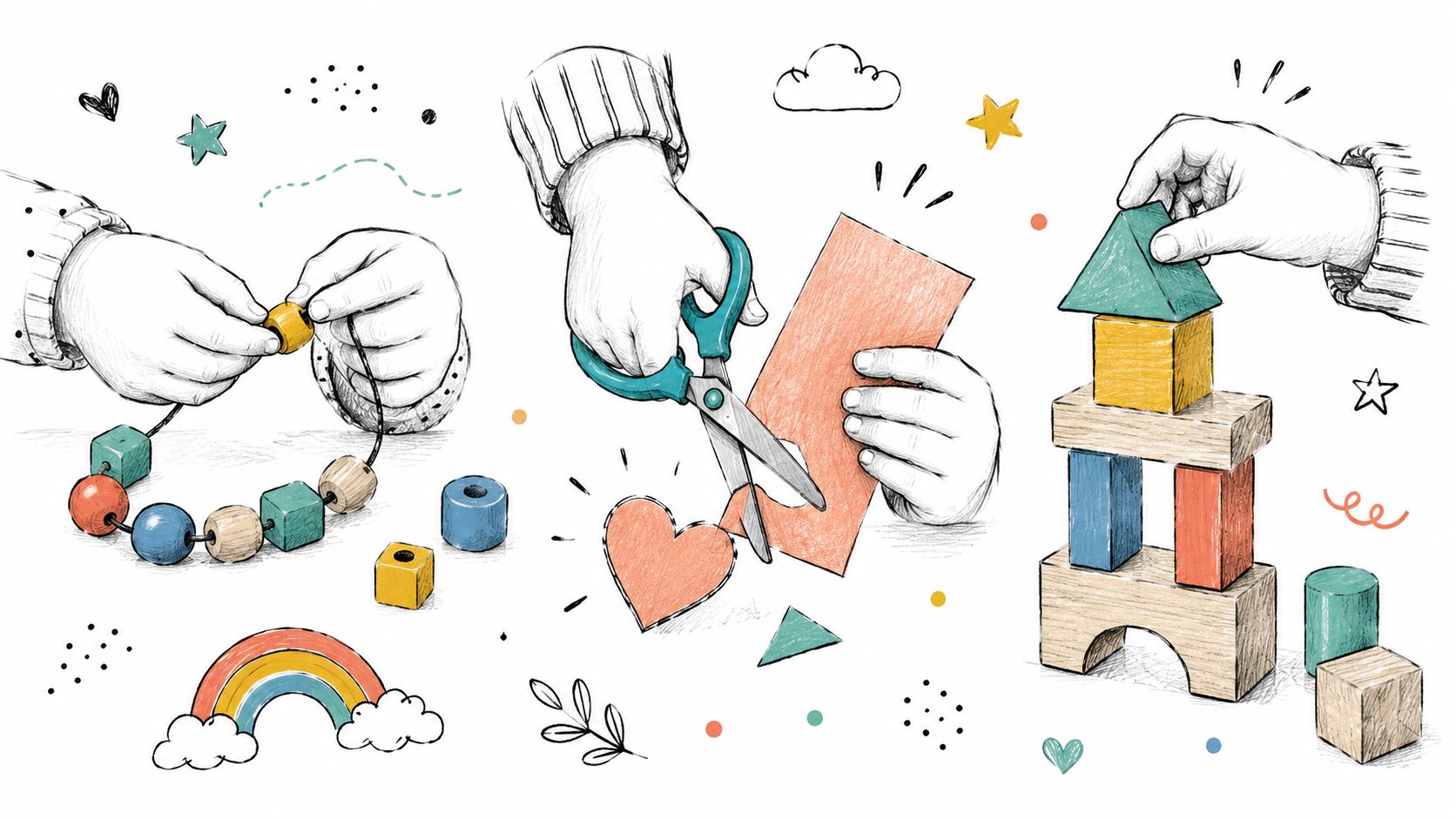
- Threading with large beads, pasta tubes or cardboard rings
- Tearing paper for collage work
- Child-safe scissors for snipping playdough, straws or paper strips
Some children need a bigger starting point. If drawing on paper feels tricky, try painting with water on a wall outside, making marks in shaving foam, or drawing in sand first.
Keep it manageable
You don't need a packed schedule. Fine motor practice works best when it feels ordinary and repeatable.
A simple weekly rhythm might include:
| Day-to-day moment | Fine motor opportunity |
|---|---|
| Breakfast | spoon use, picking up small food pieces |
| Laundry time | pegs, sorting socks, pulling sleeves through |
| Bath time | squeezing flannels, pouring from cups |
| Outdoor walk | collecting leaves, carrying stones, opening snack pots |
| Quiet play | stickers, dough, crayons, puzzles |
Short bursts are often enough. A few minutes here and there can build more confidence than one long activity that ends in tears.
How Play and Learning Environments Nurture Skills
Children's hand skills don't develop in isolation. They grow in response to what the environment invites them to do.
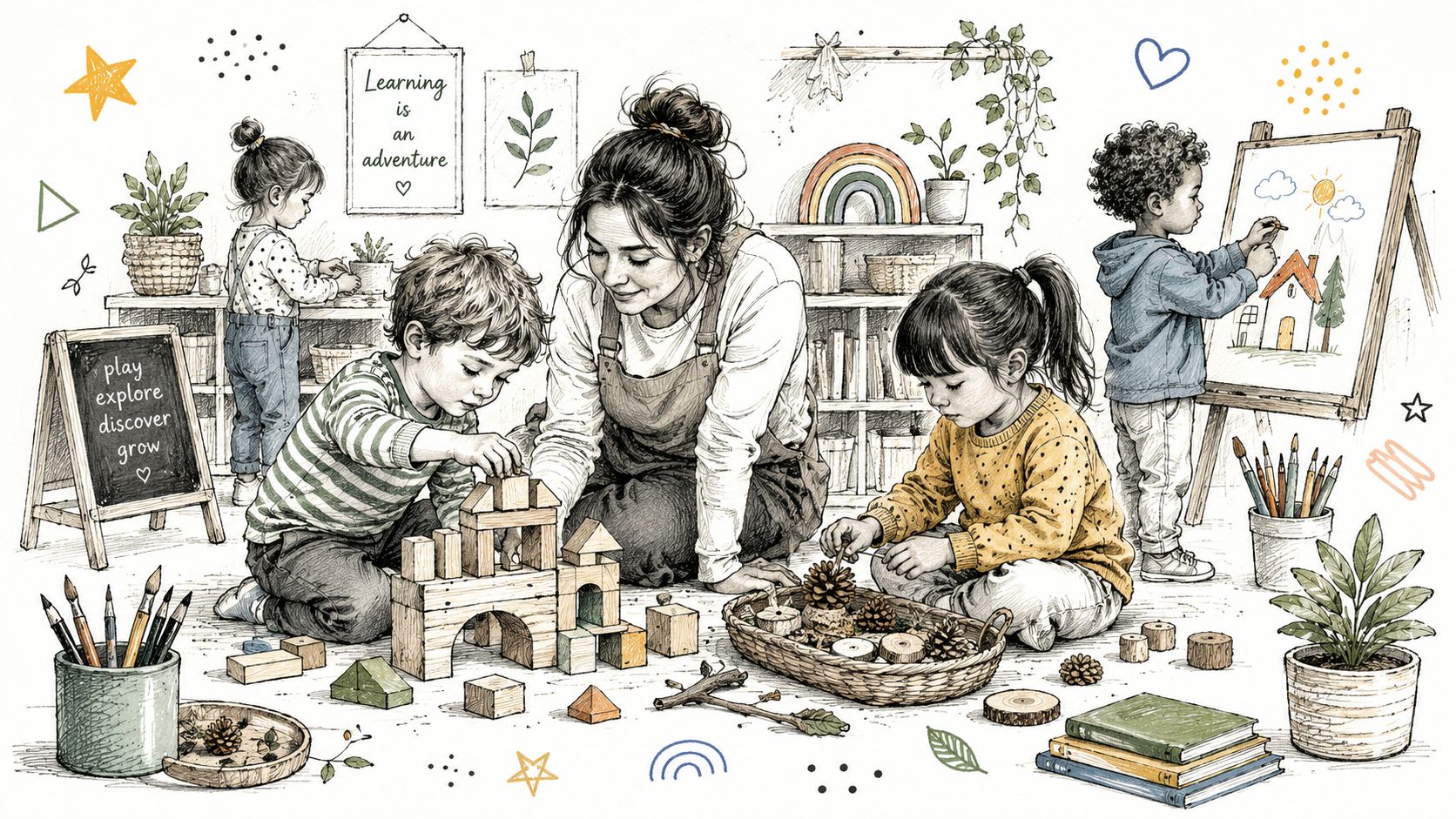
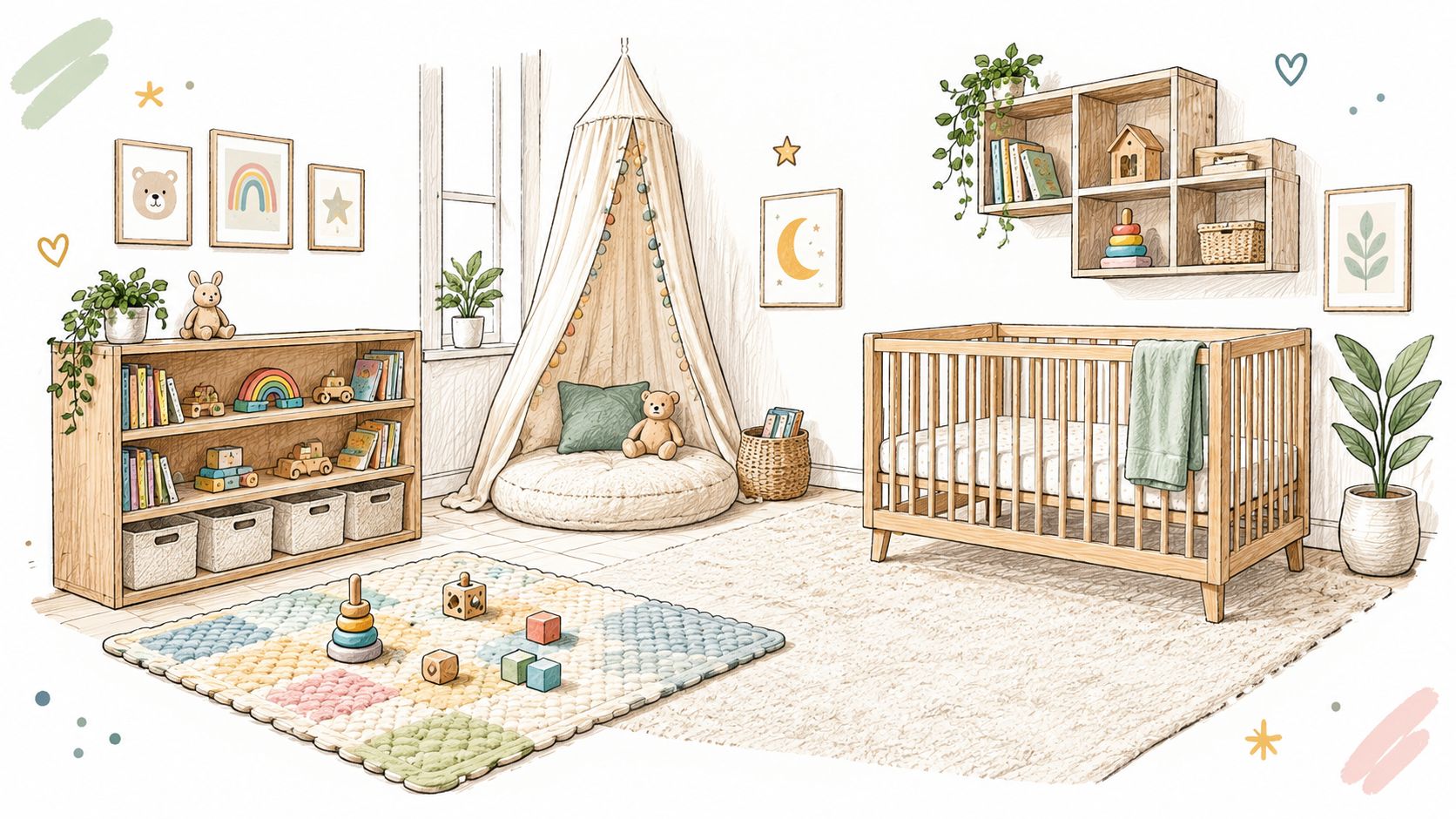
Many early years settings support development best when children can move between active play, sensory exploration and table-based activities. A well-planned space often includes open-ended materials, time to experiment, and everyday tools that children can handle safely with support.
What to look for in a supportive environment
A useful play and learning space often offers:
- Varied textures such as sand, water, clay, dough, paper, fabric and natural materials
- Small tools like paintbrushes, chunky crayons, tweezers, spoons and child-safe scissors
- Room to move so children build postural strength alongside hand control
- Real tasks including pouring, tidying, carrying and simple self-care routines
The prompt research for this topic found that UK children who spend less than 20 minutes daily in unstructured outdoor play are 2.5 times more likely to struggle with fine motor tasks such as buttoning or using scissors by age 4. It also notes that experts recommend sensory-rich environments with varied textures and natural objects to support dexterity.
That doesn't mean a child needs a perfect set-up. It means regular access to different sensations, tools and movements helps.
Why mixed experiences matter
A child might strengthen their hands by squeezing mud, improve bilateral coordination while holding a bowl and stirring, and refine pencil control later at the table. These experiences connect.
If you want a wider look at how play supports development across the early years, this article on the power of play in nurturing young minds is worth a read.
A strong fine motor environment isn't the one with the most equipment. It's the one that gives children safe, repeated chances to touch, grip, carry, squeeze, pinch and create.
Recognising When Your Child Might Need Extra Support
Most children show uneven development. They may be advanced in language and slower with tools, or physically confident but less interested in drawing. That can be completely normal.
Still, there are times when it's wise to look more closely. You might want advice if your child consistently avoids hand-based tasks, seems unusually frustrated by simple fine motor activities, or isn't making gradual progress over time.
Signs worth noticing
Some examples include:
- Ongoing difficulty with grasping toys, crayons, spoons or other everyday objects
- Very awkward or weak hand use beyond the stage you'd usually expect
- Avoiding two-handed tasks such as holding paper while drawing or using one hand to steady and one to work
- Struggling with self-care like feeding, dressing fasteners or using simple tools
- Becoming distressed quickly during puzzles, mark making, stacking or similar activities
A single sign on its own doesn't diagnose anything. Patterns matter more than one difficult afternoon.
Gentle next steps
If you're concerned, start with a conversation. You could speak to:
- Your health visitor for early developmental guidance
- Your GP if you want a broader check-in
- Your child's key person or nursery team if they attend a setting and you'd like to compare what they see
Early support can be very helpful, and asking questions early is a strength, not an overreaction.
Frequently Asked Questions About Fine Motor Skills
Does screen time affect fine motor skills development
It can, mainly because of what it replaces. Children build fine motor skills by touching, squeezing, stacking, turning, pouring and using tools. If a lot of time goes to passive screen use, there's less time left for those hands-on experiences. The issue isn't only the screen itself. It's the lost opportunity for real-world practice.
My child is left-handed. Should I do anything differently
Mostly, no. Left-handed children don't need to be corrected or steered towards the right hand. They need comfortable access to tools and enough space to move naturally. Place materials where they can reach them easily, and if you're offering scissors or cutlery, check that the shape works well for left-handed use.
How can I tell the difference between a small delay and a bigger concern
Look at the overall picture. Ask yourself whether your child is progressing slowly but steadily, or whether they're getting stuck, avoiding tasks, or becoming unusually frustrated across many situations. Compare patterns over time, not one isolated skill. If you're unsure, speaking to a professional is far more useful than trying to self-diagnose from milestone lists.
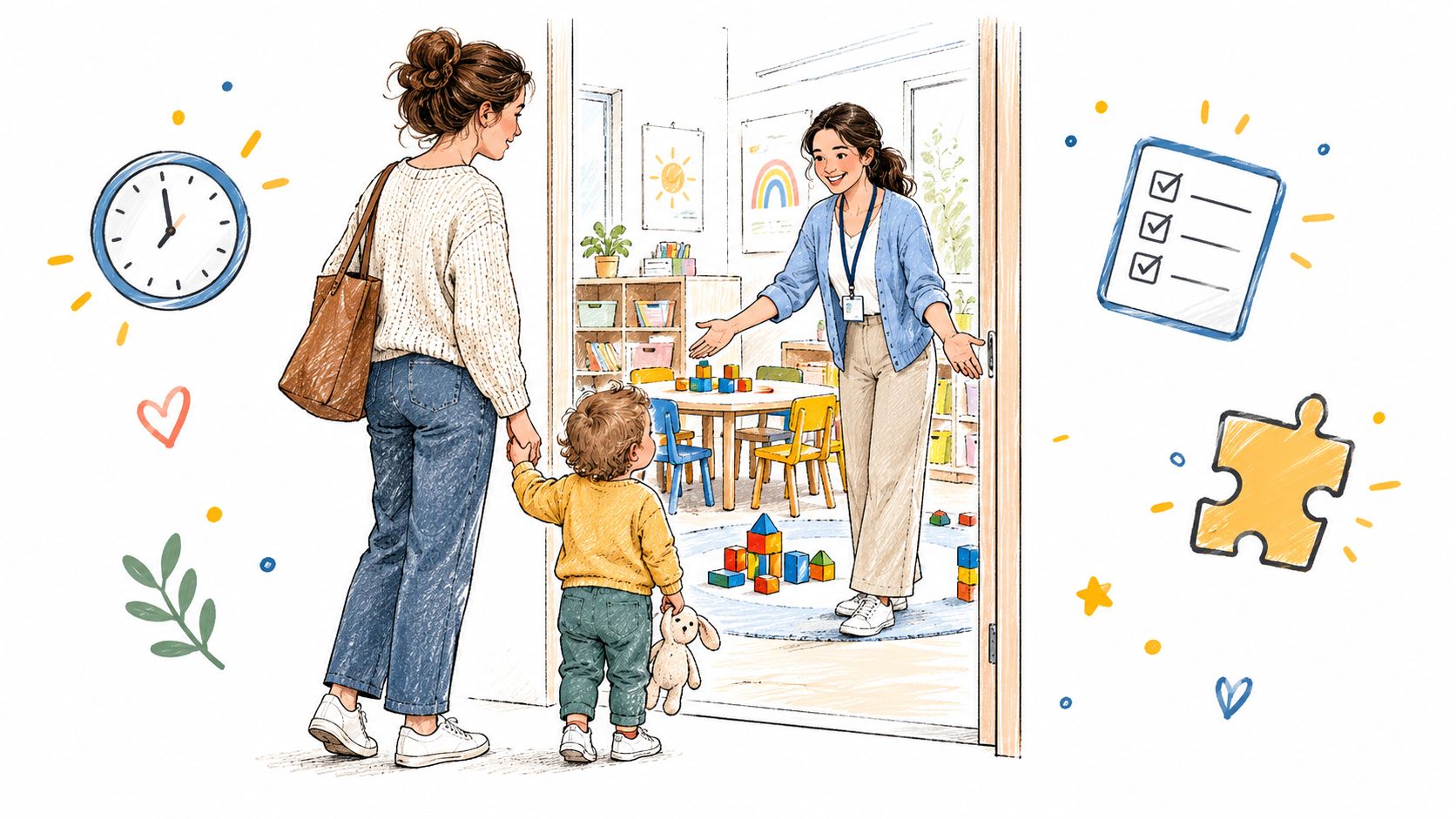
If you're looking for a nurturing early years environment where children can learn through play, explore new skills and grow in confidence, Happy Tree Academy is a lovely place to start. Families are welcome to learn more, ask questions and book a visit to see whether our nursery in Northwood feels right for their child.