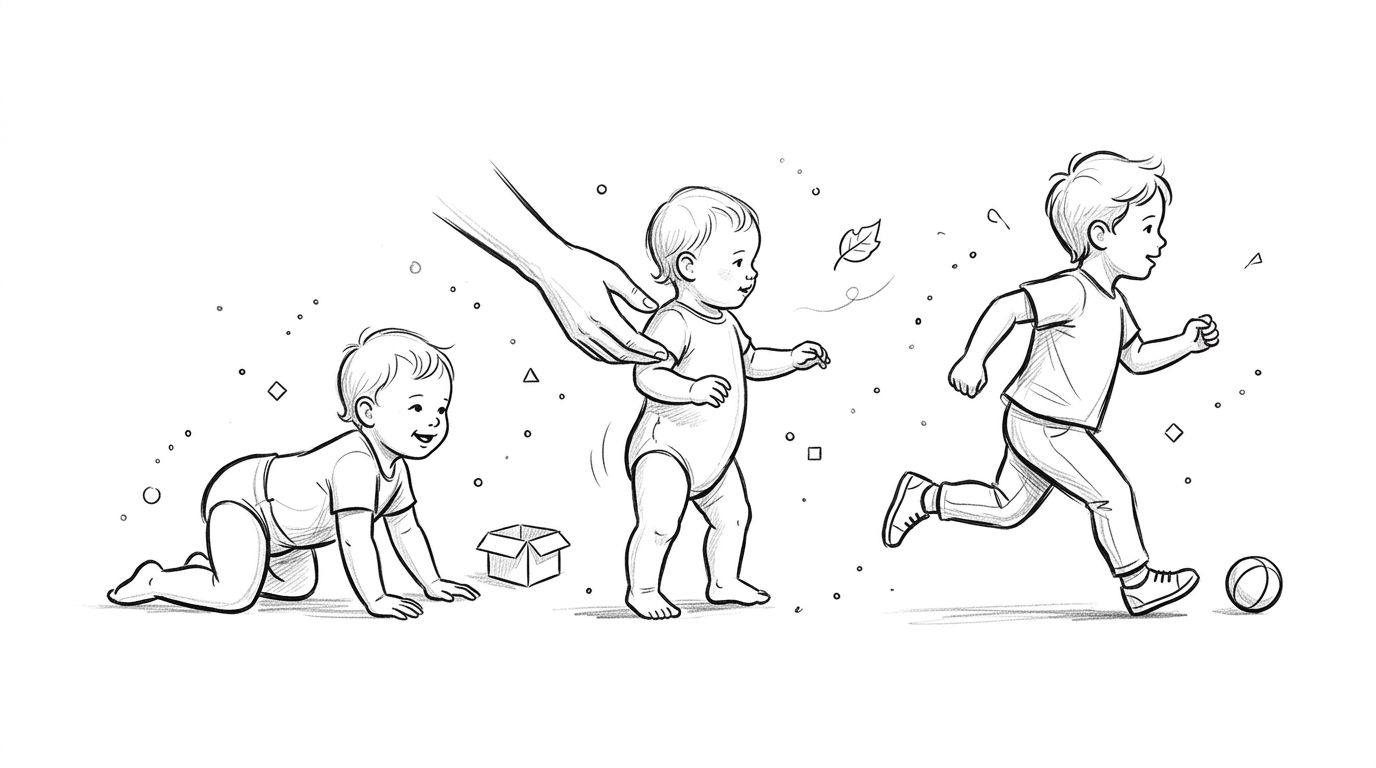

One day your baby is straining to lift their head for a second or two. A few months later, they're rolling towards the remote, pulling up on the sofa, then marching off with that determined toddler wobble. It can feel as though these changes happen all at once, yet when you're in the middle of it, it's common to wonder what's normal, what helps, and whether you should be doing more.
That's where understanding gross motor skills development can be so helpful. These are the big movement skills that use large muscle groups, including holding the head up, sitting, crawling, standing, walking, running and jumping. They're the movements that help children explore the world with their whole body.
For parents, the tricky part is that advice often comes in two extremes. You either get a clinical milestone chart with little context, or you hear vague suggestions like “just let them play”. In reality, both matter. Children do develop through play, but it also helps to know which kinds of play support which skills, and what you might expect at each stage.
From First Wiggles to Confident Strides
Gross motor skills are the foundation for movement. If you picture your child's development like building a house, these skills are the strong base. When that base becomes steadier, children can do more for themselves, from climbing onto a chair to joining in games with other children.
In the early months, development tends to follow a sequence. Infants first build control through the neck and trunk, then gain more shoulder and arm mobility. Daily tummy time helps babies strengthen the muscles needed for sitting and crawling, which supports later movement too, as explained in this guide to gross motor development.
What gross motor skills really include
Parents sometimes think gross motor skills only mean big milestones such as walking. They include much more than that.
- Body control helps a baby hold their head steady, roll and sit upright.
- Balance supports standing, changing direction and moving over uneven ground.
- Coordination helps children use both sides of the body together, such as climbing stairs or kicking a ball.
- Strength and stamina make it easier to keep going during play, walks and everyday routines.
These skills also link closely with confidence. A child who feels steady on their feet is more likely to explore, try again after a wobble, and join in with other children.
Practical rule: movement develops from the middle of the body outwards. Strong core control often comes before smoother arm and leg movements.
Why this matters beyond physical movement
Gross motor development isn't only about sports or being active outdoors. It affects daily life in simple ways. Sitting at the table, getting dressed, climbing into bed, carrying toys and walking safely all rely on these large muscle movements.
It also supports other learning. When children have enough strength and stability in their shoulders and trunk, it often becomes easier to manage finer tasks later, such as drawing, using cutlery or turning pages. That's one reason play matters so much in the early years. If you enjoy reading about how play supports all-round learning, this article on the power of play gives a helpful wider view.
A child doesn't need to master everything at once. Gross motor skills grow through repetition, trial and error, and lots of ordinary movement woven into everyday life.
A Guide to Gross Motor Milestones by Age
Parents often ask for a clear timeline, but milestones are best used as a guide, not a strict checklist. Children don't all move in exactly the same way or at the same speed. Some roll early and crawl later. Some shuffle, creep or go straight to walking.
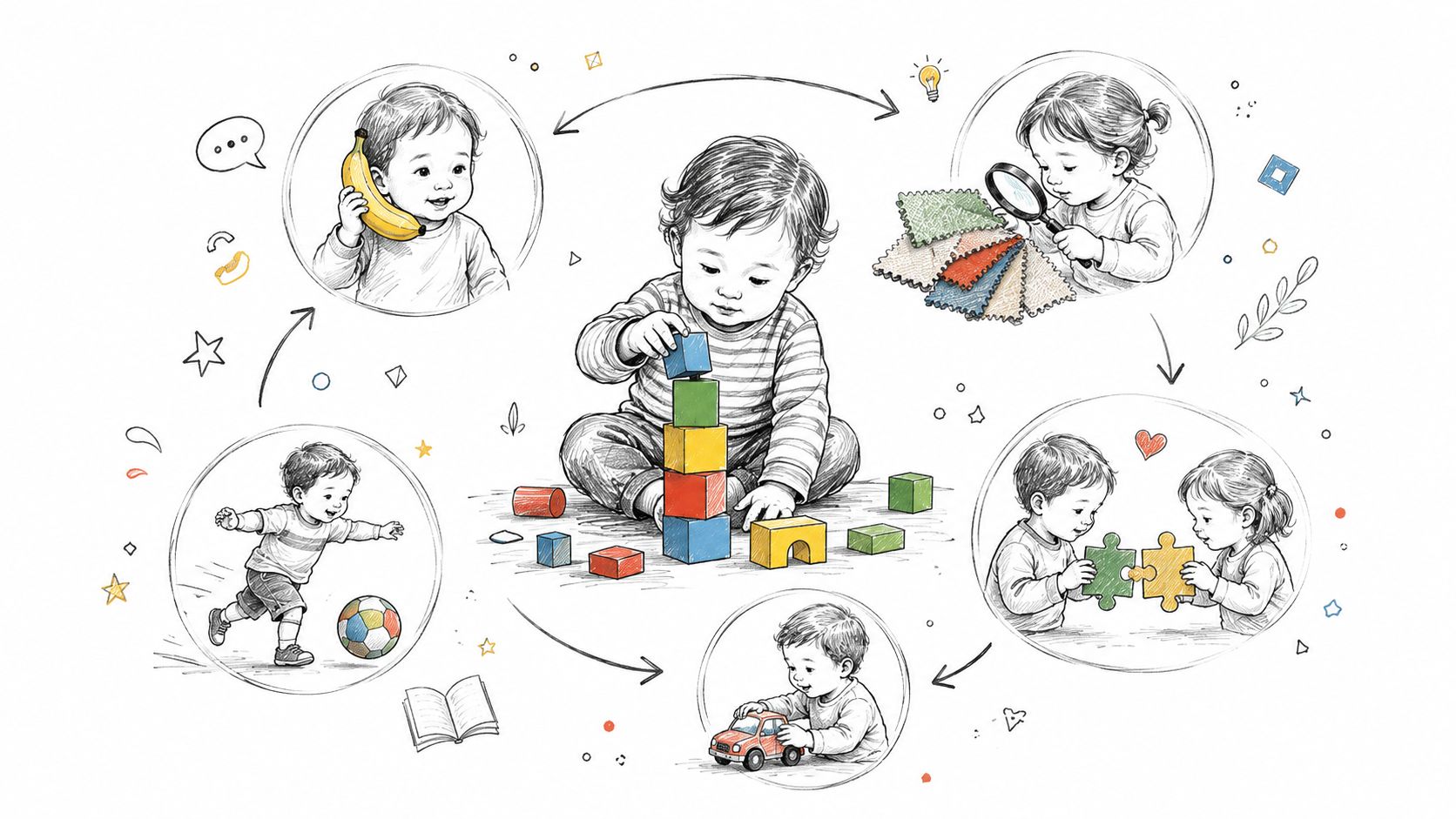
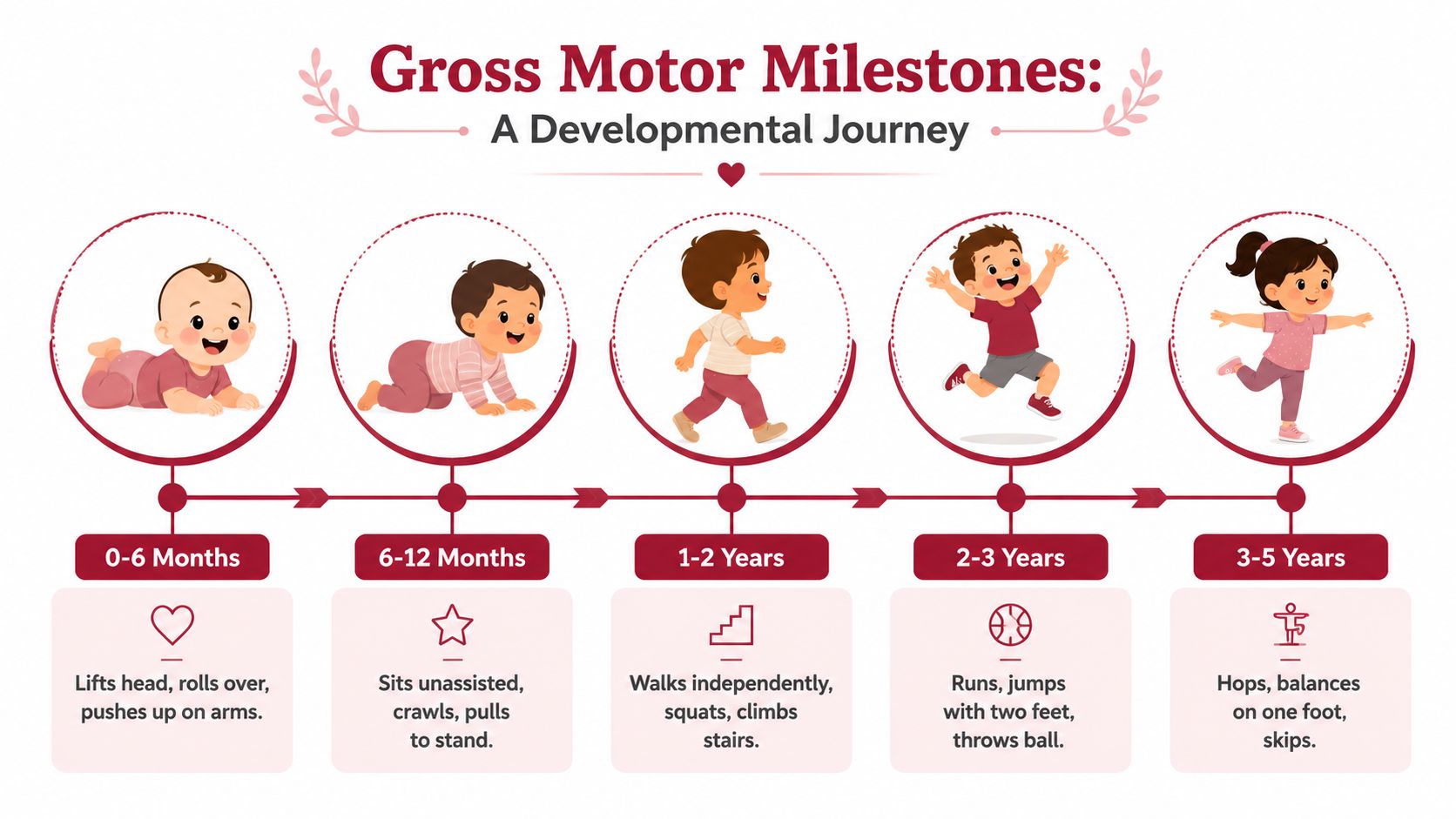
This visual overview can help you picture the broad journey.
Birth to 12 months
During the first year, babies move from reflexive movements to much more purposeful control.
| Age band | Common movement patterns |
|---|---|
| 0 to 6 months | Lifting the head, pushing up on arms, rolling, kicking legs, beginning to reach while supported |
| 6 to 12 months | Sitting without support, pivoting on the floor, crawling or shuffling, pulling to stand, cruising along furniture |
What often confuses parents is that crawling isn't identical for every child. Some babies crawl on hands and knees, some bottom-shuffle, and some find their own way to get about. What matters most is steady progress in strength, balance and body control.
One to three years
This is when movement starts to look more confident and much more energetic.
By around 13 to 14 months, children typically stand independently for a few seconds and walk with one hand held, and by 15 to 18 months they may begin kicking balls and walking upstairs with rail support, according to this overview of gross motor milestones and progression. Parents often notice that once walking begins, everything else seems to follow quickly.
In the UK, 93.3% of children aged 2 to 2.5 years achieved the expected level of development in gross motor skills during 2023 to 2024, showing that most toddlers are walking, running and jumping competently by this age, based on the UK government's child development commentary.
Many toddlers look unsteady one week and far more secure the next. That uneven pattern is often part of normal learning.
Three to five years
Preschoolers usually start linking movements together with more control. That can include running with fewer falls, jumping with two feet, climbing more confidently, balancing on one foot, hopping and, later on, beginning to skip.
At this age, parents sometimes expect polished movement. In reality, children are still practising. They may run fast but struggle to stop neatly, hop on one leg but not the other, or climb confidently and then hesitate on the way down. That's all part of building coordination.
What helps most is watching the overall direction of progress. Ask yourself whether your child is gradually gaining strength, balance and confidence, rather than whether every milestone appears on a particular date.
Simple Ways to Encourage Development Through Play
The most useful activities are often the simplest. You don't need a specialist set-up or expensive equipment. Children build skills through repeated chances to move, push, pull, climb, crawl, squat, reach and balance.
According to the UK's Chief Medical Officer, toddlers aged 1 to 2 years should have at least 180 minutes of physical activity each day, and pre-schoolers need the same total with at least 60 minutes at moderate-to-vigorous intensity, as set out in this NHS resource on gross motor skills for babies and toddlers. That can sound like a lot until you remember it doesn't have to be one long session. It's usually spread across the day through play and daily routines.
Play ideas for babies
For babies, the goal is usually strength and body control rather than speed.
- Tummy time with company helps build neck, shoulder and core strength. Lie down facing your baby, sing, chat or place a simple toy just in front of them.
- Reaching games encourage rolling and shifting weight. Try placing a rattle or soft toy slightly to one side rather than directly in front.
- Lap bouncing and supported sitting can help babies practise head and trunk control when done gently and briefly.
If your baby dislikes tummy time, shorter bursts often work better. A minute here and there still counts.
Play ideas for toddlers
Toddlers usually want movement with a purpose. They're not exercising. They're transporting cushions, chasing bubbles and climbing onto things they probably shouldn't.
Try these at home:
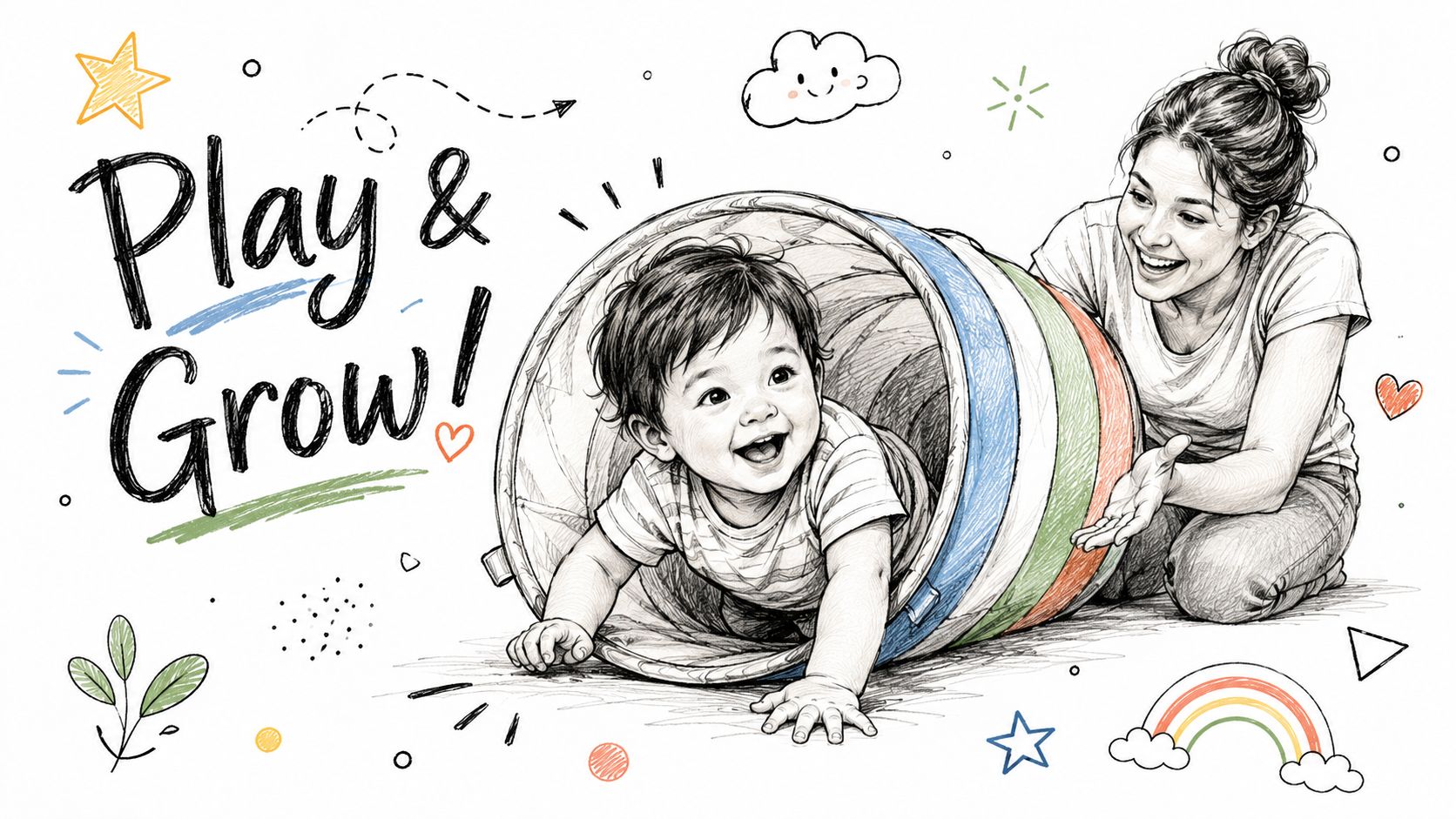
- Cardboard box tunnels support crawling, coordination and spatial awareness.
- Cushion paths help with balance. Lay sofa cushions or folded blankets on the floor and let your child step across.
- Squat and stand games build leg strength. Ask them to pick up beanbags, blocks or toy animals from the floor and place them in a basket.
- Push and pull play with a sturdy toy or loaded basket can support whole-body strength and stability.
For more everyday movement ideas, parents often find inspiration in practical round-ups such as these nursery activity ideas.
Try to think in actions, not activities. Crawling, reaching, stepping over, carrying and throwing are the real building blocks.
Play ideas for preschoolers
Older children often enjoy simple challenges.
Obstacle courses
Use cushions, masking tape lines, low stools and boxes. Stepping over, crawling under and balancing along a line all help coordination.Ball play
Rolling, throwing and kicking support timing, balance and body awareness. Different ball sizes create different challenges.Music and movement
Action songs, dancing, marching and freeze games help children start and stop their bodies with control.Outdoor exploration
Walking on grass, slopes, bark, paving or sand gives children varied movement experiences that indoor floors can't always provide.
A simple way to build movement into the day
If you're short on time, think about moments rather than sessions.
- Morning can include a few minutes of stretching, crawling or dancing.
- During routines children can carry a nappy, fetch shoes or walk to the bath.
- After meals a short walk, park visit or garden play can release energy.
- Before bed slower movement like animal walks or gentle floor play can still support coordination.
Consistency matters more than perfection. Small bursts of active play, repeated day after day, add up.
The Role of Nursery in Building Physical Confidence
You drop your child off in the morning and, by pickup time, they have spent the day climbing a small step, crawling through a tunnel, carrying a toy basket, and running across grass with friends. To an adult, it can look like ordinary play. For a young child, it is practice. Each small movement is like adding another brick to a steady, reliable foundation.
A well-planned early years setting gives children regular chances to use their whole body in ways that match their stage of development. The goal is not formal exercise sessions. It is a day organised so movement happens naturally, with space to repeat, rest, try again, and slowly feel more sure of what the body can do.
UK government guidance explains that children aged 1 to 4 years should be physically active for at least three hours a day, and it notes that outdoor environments can support stamina and locomotor skills such as crawling, hopping and skipping in early years practice, as outlined in this guidance on gross motor skills in the early years.
That helps explain why nursery can make such a difference. At home, you may offer lovely opportunities for movement, but nursery often adds something parents cannot always provide every day: a predictable rhythm of active play, child-sized equipment, and other children to learn alongside.
What parents can look for in any nursery
The most supportive settings usually have a few things in common:
- Daily outdoor time so children can move in bigger spaces and experience slopes, grass, paths and other surfaces
- Clear indoor floor space for babies and toddlers to roll, crawl, sit, cruise and change position safely
- Simple equipment that invites action such as balls, mats, low climbing pieces, ride-ons and push toys
- Adults who observe carefully and offer the right level of help without taking over
Children often copy what they see. One child watches another jump off a low step, bend to pick up a ball, or balance along a line, then decides to have a go too. That social element can build confidence in a gentle, natural way.
Why confidence matters as much as skill
Gross motor development is not only about what a child can do. It is also about whether they trust their body enough to try.
Some children have the strength for a new movement but hang back because it feels unfamiliar. Others rush in happily and still need practice to do it with control. Nursery adults often support both patterns in the same simple way: they stay close, keep the challenge manageable, and let repetition do the teaching.
Children build physical confidence through repeated chances to practise, with calm adults nearby and no pressure to perform.
If you are comparing childcare options, it can help to ask how active play is woven through the whole day rather than saved for one slot. General information on the benefits of outdoor learning in early years can also help you picture what that looks like in practice. If you're looking locally, Happy Tree Academy is one Northwood option for families exploring day nursery care for young children.
Understanding Developmental Delays and Finding Support
Most children don't follow a perfectly tidy timeline. A slower patch, an uneven skill, or a child who dislikes a certain kind of movement doesn't always mean there's a problem. Parents still know when something feels different, and it's worth trusting that instinct.
What matters most is the whole picture. Is your child making progress over time? Do they seem unusually floppy or very stiff? Do they avoid bearing weight through their legs or one side of the body? Are they becoming more frustrated because movement feels hard?
Signs that are worth discussing
It can help to look for patterns rather than single moments.
- Ongoing difficulty with basic movement such as lifting the head, sitting, crawling or walking compared with their own overall development
- A clear difference between the two sides of the body when reaching, crawling or standing
- Loss of a skill they had previously used with ease
- Strong resistance to movement that seems linked to discomfort, weakness or poor stability
None of these automatically points to a serious problem. They mean it's sensible to ask for advice.
What support can look like at home
Many guides list milestones but don't give parents practical ways to help. Yet simple home ideas can support strength and postural control, especially in smaller spaces. This advice on supporting gross motor skills with reduced motor abilities highlights low-cost options such as den-making, cardboard tunnels and fabric gradients.
That matters because children don't need specialist equipment to practise useful movements. A blanket draped over chairs can become a crawl-through den. A firm cushion under a mat can create a gentle slope for climbing. Rolled towels under a playmat can make floor play more interesting and active.
If you're worried, start two things at once. Keep play simple and regular at home, and speak to a professional who can look at your child's development in context.
Who to contact first
For most families, the first step is a Health Visitor or GP. They can listen to your concerns, look at your child's broader development and, if needed, help you access further support.
It often helps to go in prepared. Make a note of what you've noticed, when you first noticed it, and which movements seem easy or difficult. Short videos of your child playing, crawling, standing or walking can also be useful during appointments.
Early support isn't about labelling a child. It's about understanding what they need and making everyday life easier.
Your Child's Physical Journey Key Takeaways
Gross motor skills development can seem complicated when you're looking at lists of milestones online. In everyday life, it's simpler than that. Children learn to move by moving often, in ways that feel playful, safe and worth repeating.
A few key points are worth keeping in mind.
- Big movements come first. Head control, rolling, sitting, crawling, standing and walking all build on each other over time.
- Play does the heavy lifting. Tummy time, floor play, dancing, carrying, climbing and outdoor exploration all support strength, balance and coordination.
- Daily movement matters. Short bursts through the day count, especially for toddlers and preschoolers.
- Variation is normal. Children reach milestones at different times and may be confident in one skill while still practising another.
- Support can be simple. Cushions, boxes, blankets, balls and open floor space often provide plenty of challenge.
- Concerns are worth sharing. If something doesn't feel right, speaking to a Health Visitor or GP is a sensible and reassuring next step.
Many parents feel pressure to do everything perfectly. Children don't need perfect. They need time, space, repetition and encouragement.
If you're exploring childcare options, talking with a local nursery can help you understand how early years settings support physical development alongside communication, confidence and play.
If you'd like to learn more about childcare and early years development, Happy Tree Academy shares helpful information for parents and welcomes families who are exploring nursery options in Northwood.