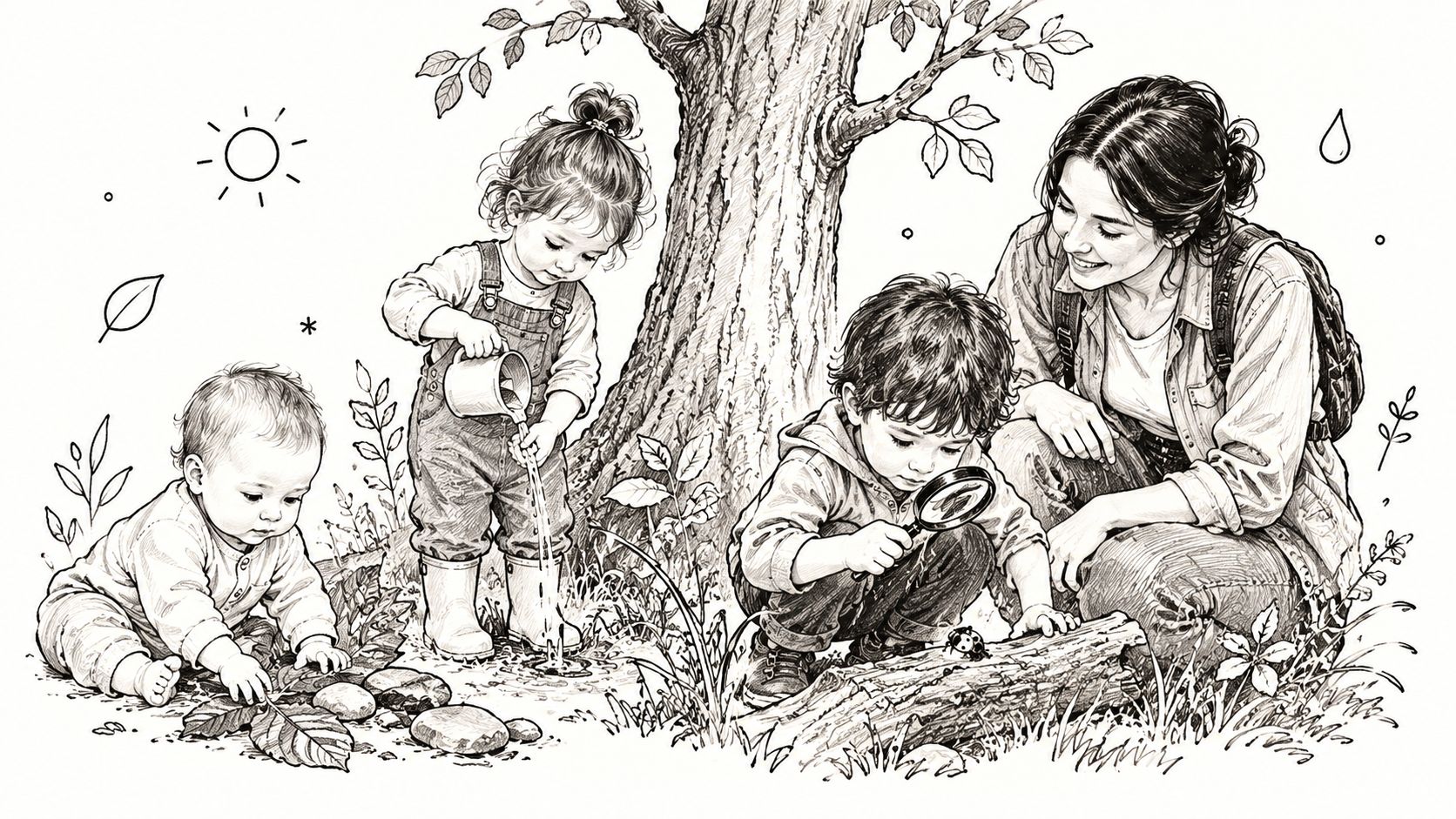

Have you considered how much learning can happen outside, without specialist equipment, a perfect garden or a carefully planned lesson? From babies exploring textures to preschoolers investigating nature, outdoor learning activities offer rich sensory, social and cognitive experiences through ordinary moments. A puddle, leaf, breeze or patch of soil can become an invitation to notice, question, move and communicate.
Outdoor learning is already becoming a familiar part of children's education in England. The Children's People and Nature Survey for England 2023 found that 87% of children and young people had spent time outside at school most days or every day in the previous week, while 33% had lessons or activities outside that were not PE with the same regularity. For young children, this matters because learning through movement, play and exploration can be woven into everyday routines.
You don't need a woodland or a large private garden to begin. A balcony, shared green space, doorstep, courtyard or local park can provide useful opportunities, provided adults choose suitable activities, supervise carefully and adapt expectations to the child's age, confidence and needs.
1. Nature Exploration and Observational Learning
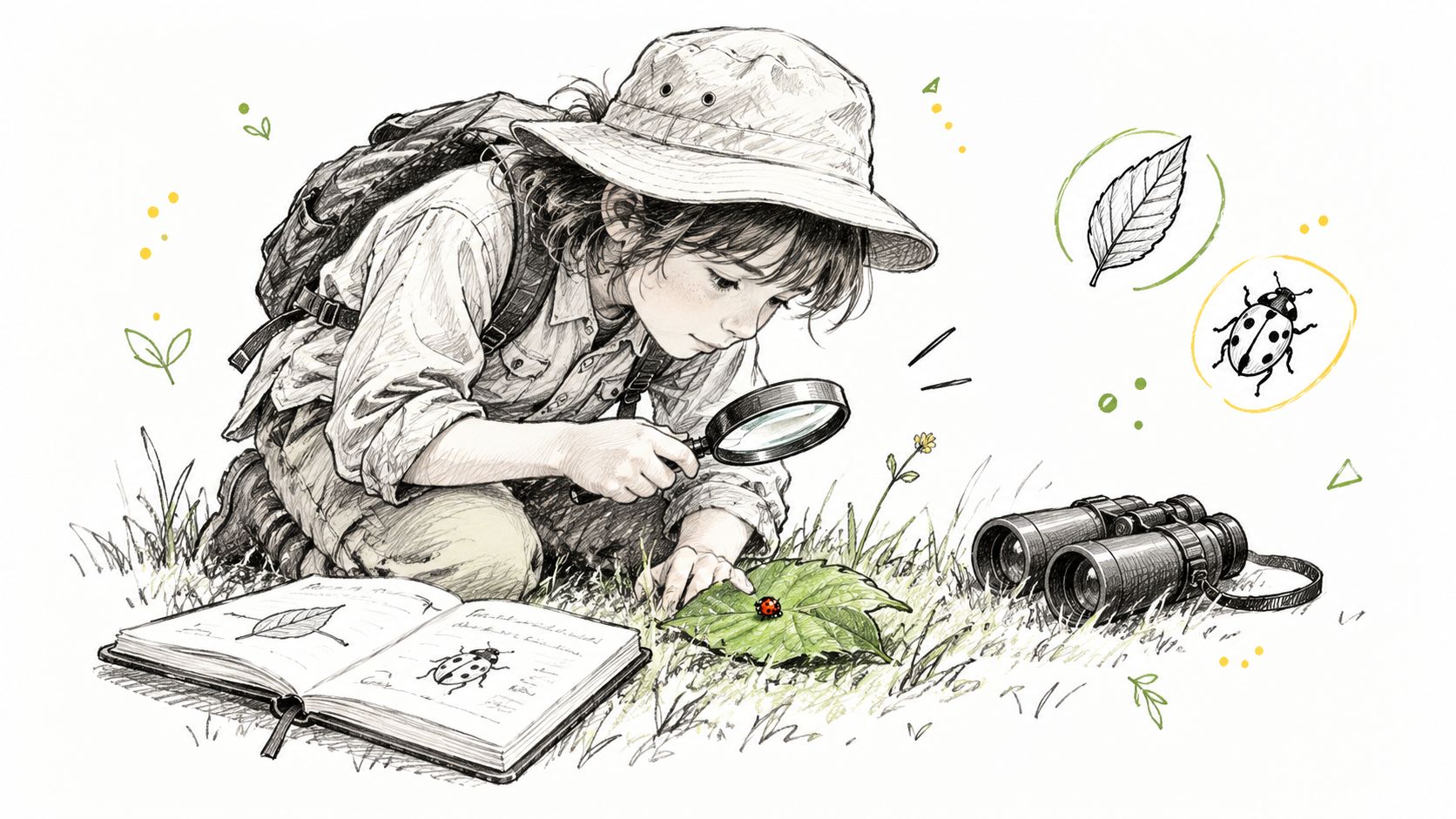
A nature walk doesn't need a destination. Young children can learn by pausing beside a plant, feeling bark or watching an insect move across a leaf. The important part is helping them slow down, notice details and return to ideas over time.
Babies may explore natural textures with an adult's support, while toddlers can compare rough and smooth surfaces, spot colours or collect a few safe, fallen leaves. Preschoolers can look for patterns, follow animal signs in mud or sand, and draw what they've seen. These experiences encourage attention, language, early scientific thinking and respect for living things.
Make noticing the main activity
Begin in a familiar outdoor area and keep the first observations short. Ask questions such as:
- What can you feel? Compare soft moss, smooth pebbles and rough bark.
- What has changed? Revisit the same spot and look for new leaves, fallen seeds or signs of rain.
- What do you think happened? Talk about a trail in mud, a nibbled leaf or a feather on the ground.
- How can we record it? Invite older children to sketch, take a photograph with an adult's device or make simple marks.
Teach children to move with care around wildlife and return collected items when appropriate. A small notebook or child-friendly identification guide can help them revisit discoveries rather than rushing from one object to the next. For more ideas about the developmental value of this approach, explore these benefits of outdoor learning in the early years.
2. Outdoor Art and Creative Expression
Outdoor art gives children room to create without worrying about keeping every mark within a sheet of paper. A toddler might paint a wall with water, a preschooler might arrange leaves into a face, and an older child might build a temporary sculpture from sticks and stones.
The finished artwork matters less than the process. Children select materials, test ideas, notice colour and texture, and explain choices. They also experience impermanence. Water marks disappear, leaves move in the wind and chalk washes away, helping children understand that art can be about experimenting rather than producing a perfect result.
Let children lead the creative direction
Prepare washable materials and a small collection of safe, natural or reclaimed items. You could offer leaves, petals, twigs, cardboard, chalk and water, then allow children to decide what they want to make.
Creative freedom matters: Ask, “Tell me about what you've made,” rather than showing children what their artwork should look like.
Babies can enjoy supervised sensory contact with large, safe materials, while toddlers may press leaves into damp soil or make marks with chunky chalk. Preschoolers can sort materials by colour, create patterns or explain a story behind a nature collage. Photograph temporary work so children can revisit it later, and rotate materials with the seasons to keep the experience fresh. These creative activities for toddlers can also inspire simple ideas for home.
3. Physical Movement and Active Play
Children develop physical confidence by moving in different ways, not only by running across flat ground. A grassy slope, a low step, a puddle or a marked path can encourage balancing, stepping, jumping and changing direction.
For babies, floor time outdoors can support reaching, rolling and crawling on suitable surfaces. Toddlers might walk along a line, step over a small object or chase bubbles. Preschoolers can create a movement route with stops for hopping, jumping, balancing and throwing. Each child should face a challenge that feels manageable, with an adult nearby to offer encouragement rather than taking over.
Adapt movement to the child
Use simple prompts such as “Can you find another way across?” or “Would you like to try with my hand nearby?” This supports problem-solving and independence while respecting individual confidence.
- Running and chasing: Keep the area clear and adapt the pace for younger children.
- Jumping: Start with a line or shallow puddle before introducing a wider gap.
- Ball play: Roll first for babies, then progress to gentle throwing, catching and kicking.
- Balance: Use ground-level lines or stable surfaces and avoid placing children in unsuitable situations.
Manageable risk can help children learn to pause, assess and make decisions, but supervision remains essential, especially around uneven surfaces, water or higher challenges. Read more about gross motor skills development and look for progress in everyday actions, such as climbing steps with more control or stopping before an obstacle.
4. Water Play and Exploration
Water play combines sensory enjoyment with early scientific thinking. A baby may pat a shallow tray of water with an adult close by, while a toddler can pour between containers and notice what happens when one is full. Preschoolers can explore floating, sinking, flow and capacity through their own questions.
Try placing different-sized cups, jugs, funnels and spoons near a suitable outdoor drainage area. Ask, “Which container holds more?” or “What happens when we pour from higher up?” Children learn through repetition, watching cause and effect and changing one part of the activity at a time.
Keep water play safe and manageable
Water activities need close supervision. Use waterproof aprons or old clothing, change shared water regularly and keep small objects away from babies who may mouth materials. Splashing in puddles can be enjoyable after rain, but adults should check the area first and avoid contaminated or fast-moving water.
You can also introduce simple environmental ideas without turning play into a lecture. Talk about turning the tap off, using only the water needed and collecting rainwater for plants where this is suitable. Let children notice that water changes when it freezes, warms or moves through a funnel. The activity can be calming as well as active, giving children a focused way to repeat actions and settle their attention.
5. Gardening and Growing Plants
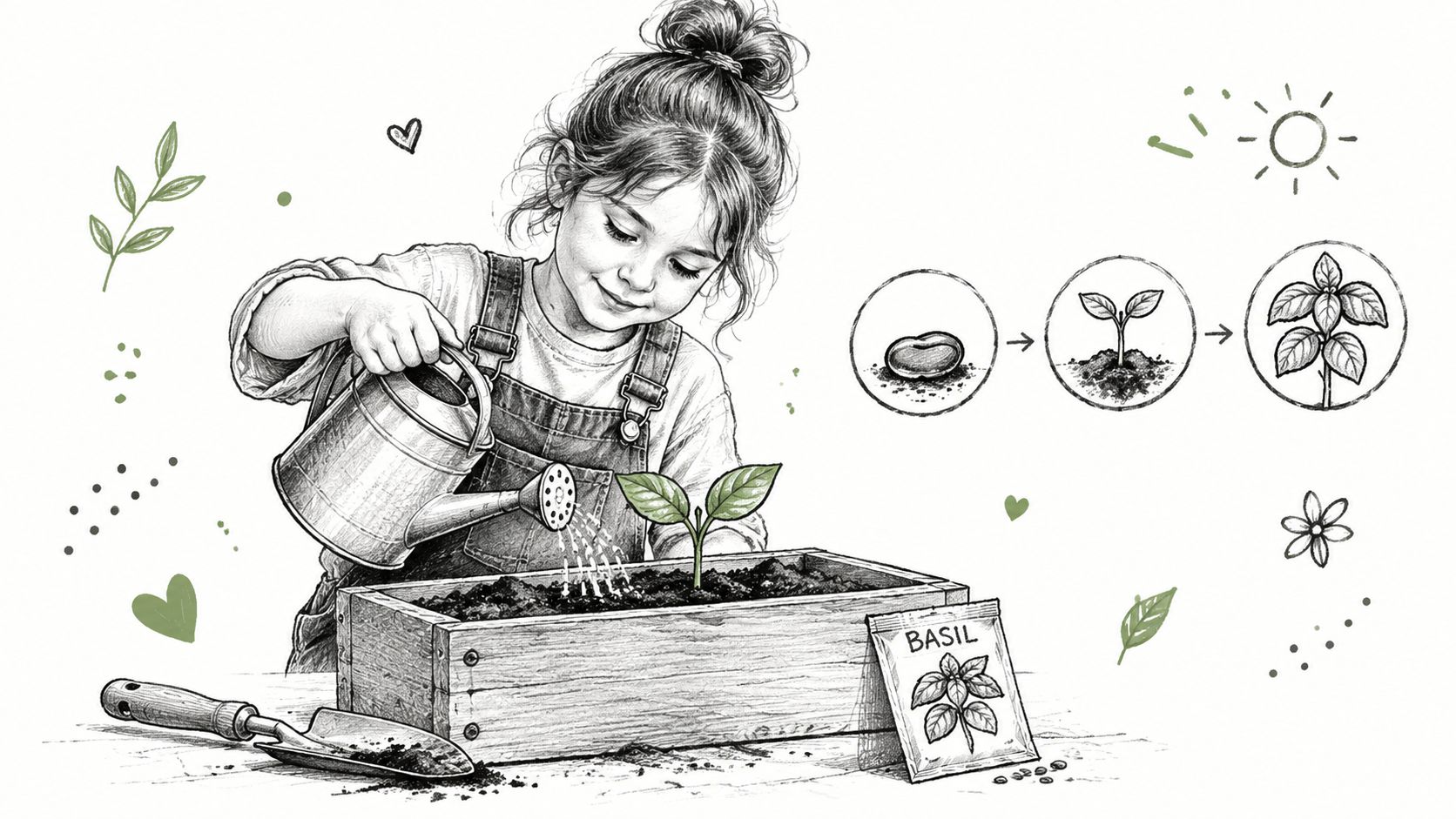
Gardening gives children a visible example of care, change and time. Planting a seed, watering it and noticing the first shoot can help toddlers connect actions with outcomes. Preschoolers can compare growth, label plants, discuss what living things need and take part in harvesting.
Start with plants that show change relatively quickly, such as cress or beans. Herbs including basil or mint offer strong scents and invite descriptive language, while vegetables can connect gardening with food preparation. Containers work well when space is limited, as long as they have suitable drainage and are placed where children can participate safely.
Turn care into a daily routine
Give each child a small, realistic responsibility. One child might check whether the soil feels dry, another might count leaves and someone else might help collect fallen plant material for composting.
A simple observation chart can include a drawing, a date and a child's words. Babies can watch adults handle soil and plants, toddlers can scoop compost or carry a small watering container, and preschoolers can measure growth informally or make predictions. Always check plants for suitability, supervise handwashing and take care around allergies. Harvesting can lead to a conversation about where food comes from, followed by washing herbs or arranging produce for a snack.
6. Outdoor Games and Cooperative Play
Outdoor games help children practise social skills while their bodies are moving. A toddler may learn to wait for a turn rolling a ball, while preschoolers can follow simple rules, remember roles and solve problems together.
Traditional games such as hide-and-seek, tag and relay races can be adapted so children participate at different levels. A child who doesn't want to run might hold a marker, choose the next hiding place or help count turns. Cooperative challenges often work better than games focused only on winning, particularly for children still learning how to manage disappointment.
Build fairness into the game
Explain one rule at a time and practise before expecting children to remember everything. Rotate roles so that no child is always the chaser, leader or person who waits.
- Tag and chase: Use a clear boundary and allow walking or gentle movement.
- Hide-and-seek: Offer visible hiding places and support children who are still learning the rules.
- Relay activities: Let children carry, roll or pass an object according to their abilities.
- Scavenger hunts: Search together for colours, shapes or textures rather than competing to finish first.
Afterwards, ask what felt fair, how the group solved a problem and what could change next time. This short conversation supports communication, empathy and reflection without making the game feel like a formal lesson.
7. Music and Sound Exploration Outdoors
The outdoors offers a changing soundscape. Children can listen for birds, traffic, footsteps, wind, water and voices before making their own rhythms. This helps babies tune into differences in volume and pitch, gives toddlers new descriptive vocabulary and supports preschoolers to create patterns and musical responses.
Begin with a listening walk. Stop in one place and invite children to identify the nearest and furthest sounds they can hear. Use words such as “whooshing”, “tinkly”, “rustling”, “booming” and “quiet”. Children can then make shakers from secure containers filled with larger seeds or stones, provided an adult prepares and supervises the materials carefully.
Make sound without damaging the environment
Show children safe ways to tap suitable objects, such as a wooden surface, rather than hitting living plants or fragile habitats. They might tap a steady beat, copy a natural sound or take turns leading a rhythm.
Older toddlers can shake, stop and copy, while preschoolers can create a repeated pattern for others to follow. Twigs, shells or reclaimed materials may inspire simple sound-makers, but check every item for sharp edges, loose parts and suitability for the child's age. You could record a short sound collection with an adult's device and listen again later, asking children which sounds they recognise and how they might recreate them.
8. Outdoor Storytelling and Imaginative Play
A familiar outdoor area can become a different place when children add a story. A blanket may become a boat, a basket may carry pretend food and a group of leaves may become a map. Imaginative play gives children space to practise language, negotiate roles and express feelings through characters.
Babies often respond to repeated songs, gestures and simple stories. Toddlers may act out caring for an animal or running a pretend shop. Preschoolers can create longer narratives, assign roles and retell familiar stories using different parts of the outdoor area.
Follow the child's idea
Offer an open prompt, such as “Who might live here?” or “Where could this path lead?” Then give children time to develop the answer. Avoid directing every detail. If a child decides that a pile of leaves is a hospital, join the play by asking what the patients need rather than correcting the idea.
Simple props can extend the story, including blankets, baskets, cardboard tubes or soft toys. Adults can model new vocabulary and help children connect events, but frequent interruptions can break the flow. Photographing a completed den or recording a child's retelling can help families revisit the story later, provided privacy and consent are considered appropriately.
9. Seasonal Exploration and Environmental Awareness
The natural world changes throughout the year, giving children a reason to revisit the same place. In spring, they might notice new shoots or birdsong. Summer can bring water play and active movement, while autumn offers leaves, seedpods and conversations about harvest. In winter, frost, ice and winter birds provide different opportunities for observation.
Babies can experience seasonal differences through suitable clothing, light, temperature and sound. Toddlers can match leaves by colour, feel frost with an adult's guidance or notice that puddles change. Preschoolers can make predictions, compare photographs and talk about how plants and animals respond to changing conditions.
Create a seasonal record
Choose one viewpoint, such as a tree, planter or section of pavement, and revisit it regularly. Children can draw what they see, dictate observations or take photographs with adult support. Over time, these records encourage memory, comparison and early understanding of cycles.
Children don't need to experience every season in a perfect way. They need repeated chances to notice change safely and talk about what they see.
Seasonal materials can also be used in later sensory or creative activities, but avoid taking living plants, disturbing nests or collecting anything that could be harmful. Adapt clothing, shade, drinking water and the length of outdoor time to the weather. Poor weather may require a shorter activity, but it doesn't automatically make outdoor learning impossible.
10. Outdoor Learning Through Food and Cooking
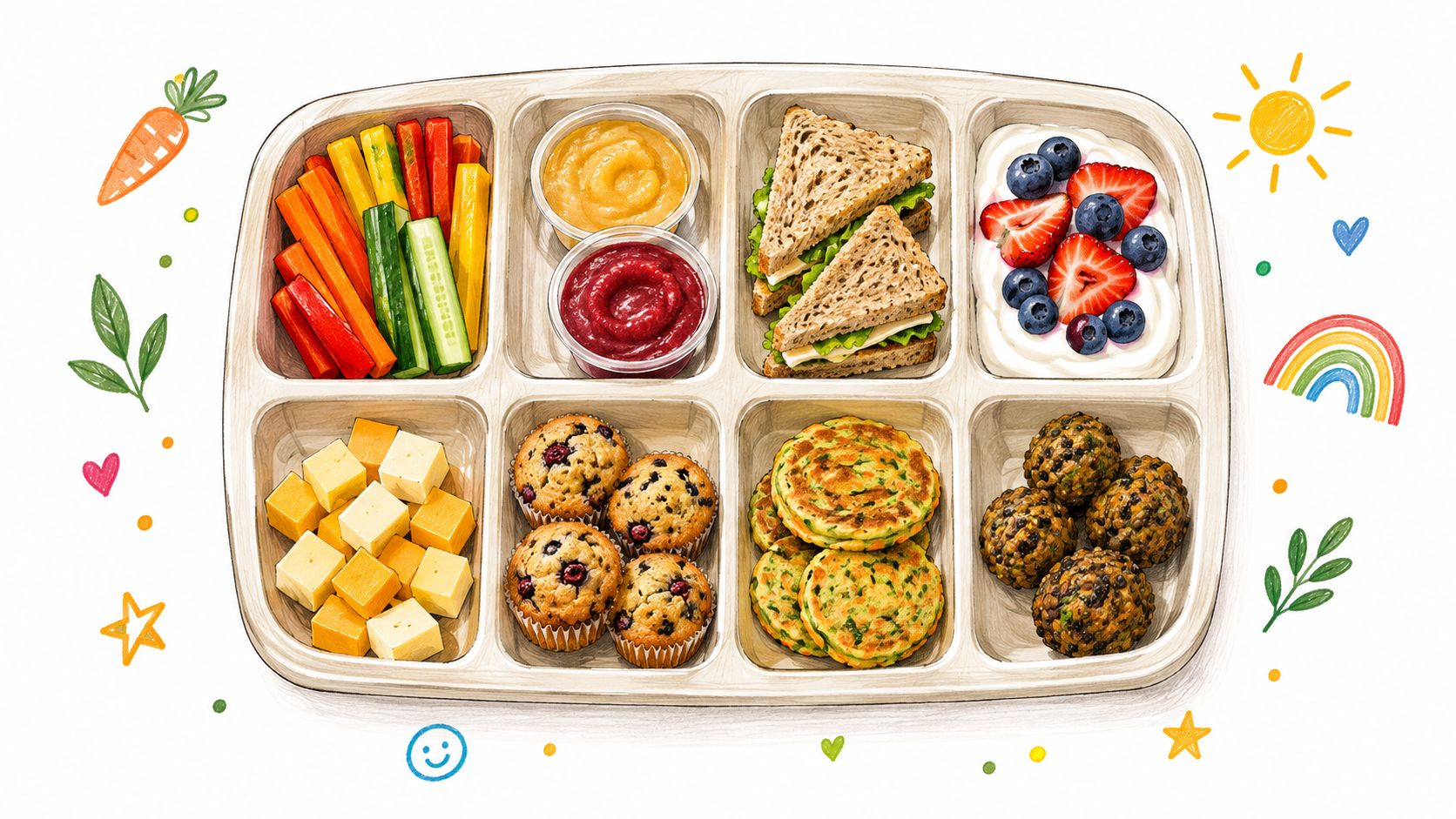
Food activities outdoors bring together practical skills, sensory exploration and conversation. A picnic can introduce sharing and independence, while washing salad vegetables or arranging fruit gives toddlers manageable tasks. Preschoolers can help choose ingredients, discuss where food comes from and describe tastes, textures and smells.
Keep preparation simple and age appropriate. Babies can watch adults handle food safely, toddlers might wash produce or place pieces into a bowl, and preschoolers can help assemble a cold meal or blend ingredients with an adult managing equipment. Gardening can make the connection even clearer when children taste herbs or vegetables they've helped care for.
Make safety part of the routine
Start with handwashing and explain why food needs to be handled carefully. Adults should manage knives, hot surfaces and electrical equipment, while children take part in safe preparation.
- Choosing ingredients: Let children select between suitable options.
- Preparing food: Offer washing, tearing, arranging or stirring tasks.
- Talking about taste: Use words such as crunchy, juicy, bitter, sweet or soft.
- Sharing the meal: Encourage children to serve themselves where appropriate and notice others' needs.
Check allergies and dietary requirements before planning the activity, and avoid presenting unfamiliar foods as something children must eat. For further ideas, explore these EYFS healthy eating activities.
10-Item Comparison: Outdoor Learning Activities
| Activity | Implementation complexity | Resource requirements | Expected outcomes | Ideal use cases | Key advantages |
|---|---|---|---|---|---|
| Nature Exploration and Observational Learning | Low–Moderate (planning, supervision) | Outdoor space, simple tools (magnifier, journal) | Observational skills, scientific thinking, patience, vocabulary | Nature walks, biodiversity studies, observation sessions | Cost-effective, builds attention and respect for wildlife |
| Outdoor Art and Creative Expression | Low (material prep) | Natural/reclaimed materials, washable supplies, photo documentation | Creativity, fine/gross motor skills, problem-solving, confidence | Large-scale art sessions, seasonal projects, sensory art | Encourages experimentation, process-focused, eco-friendly |
| Physical Movement and Active Play | Moderate (safety management) | Open varied terrain, simple equipment, supervision | Gross motor development, strength, coordination, social skills | Playtimes, PE lessons, obstacle courses | Builds fitness, resilience, energy regulation |
| Water Play and Exploration | Moderate–High (safety, drainage) | Water source, containers, waterproof clothing, constant supervision | Fine motor skills, concepts of volume/flow, sensory regulation | Sensory stations, science experiments, warm-weather play | Highly adaptable, calming, promotes scientific inquiry |
| Gardening and Growing Plants | Moderate (ongoing maintenance) | Soil/containers, tools, seeds, watering system | Understanding plant lifecycles, responsibility, healthy eating | School gardens, long-term projects, cookery links | Visible progress boosts confidence, connects to food sources |
| Outdoor Games and Cooperative Play | Low–Moderate (rule adaptation) | Open space, minimal equipment (balls/markers), facilitator | Teamwork, communication, rule-following, physical activity | Group sessions, social-skill development, transitions | Develops cooperation and social resilience, flexible formats |
| Music and Sound Exploration Outdoors | Low (simple activities) | Found/reclaimed materials, quiet outdoor area, optional recorder | Auditory awareness, rhythm, fine motor skills, creativity | Listening walks, instrument-making sessions, sensory groups | Low-cost, enhances listening and emotional regulation |
| Outdoor Storytelling and Imaginative Play | Low (open-ended facilitation) | Natural props, flexible space, minimal materials | Language development, creativity, emotional processing, social play | Free play, literacy extension, drama and role-play | Stimulates narrative skills, high engagement and confidence |
| Seasonal Exploration and Environmental Awareness | Moderate (seasonal planning) | Seasonal materials, observation charts, appropriate clothing | Understanding cycles, pattern recognition, environmental stewardship | Year-round curriculum, climate awareness modules | Varied, sustained engagement; teaches adaptation and ecology |
| Outdoor Learning Through Food and Cooking | High (food safety, allergies) | Cooking tools, seasonal produce, hygiene supplies, supervision | Practical life skills, nutrition knowledge, fine motor, social cohesion | Garden-to-table projects, nutrition education, community meals | Teaches independence, healthy eating, cultural and social skills |
Take the Next Step Outside
Outdoor learning doesn't need to be elaborate to be meaningful. A baby touching a leaf, a toddler carrying a watering pot or a preschooler explaining why a stone sank can all be valuable moments of development. The adult's role is to notice, offer language, keep the experience safe and give the child enough time to explore rather than rushing towards a finished product.
Choose one activity that suits your current routine. You might begin with a short nature observation on the way home, water play in a washing-up bowl, chalk marks on a suitable surface or a picnic snack prepared together. Repeating a simple activity often creates richer learning than introducing something new every time, because children can revisit ideas, predict outcomes and become more independent.
Age adaptation matters more than having perfect resources. Babies need close supervision, safe materials and freedom to look, reach and feel. Toddlers benefit from clear choices, short instructions and repeated actions. Preschoolers can take on more responsibility by recording observations, negotiating roles, explaining decisions and suggesting what to try next.
Weather and access can make outdoor learning feel difficult. The Children's People and Nature Survey for England 2025 reports that 84% of children and young people spend time outside at school every day or most days, while 34% have lessons outside with the same regularity. It also highlights uneven access, with 71% saying they can easily walk to a garden and 67% saying they can easily walk to a park, playing field or playground. A 2025 UK parent survey identified lack of nearby parks or playgrounds, lack of private outdoor space, time pressure and poor weather as practical barriers. That's why small, repeatable experiences can be more realistic than waiting for an ideal forest-school day.
For early-years settings, daily access to outdoor environments or planned outdoor activities is part of the Early Years Foundation Stage expectation. Research on primary-school practice also describes outdoor provision as less consistent later on, with audited evidence showing provision in 42% of English primary schools compared with 72% in Scotland, as reported in this academic study of outdoor learning in primary schools. The message for parents is reassuring. Outdoor learning is not an extra that only some children can experience. It can be part of ordinary early education and family life, adapted to local space, weather and each child's stage of development.
If you're comparing childcare options, ask how a setting supports outdoor play, how staff adapt activities for babies and toddlers, how they manage changing weather and how they observe children's learning. The Forest School Association describes Forest School as a regular, hands-on process in a woodland or natural environment with trees, while Education Scotland states that a practitioner must hold a Level 3 OCN Forest School qualification for sessions to be regarded as Forest School. This distinction can help families understand the difference between general outdoor learning and a formally qualified Forest School programme.
Start with a few minutes, follow your child's interests and return to the same ideas often. A child who notices, moves, questions, creates and talks outdoors is building a strong foundation for confidence, curiosity, communication and independence.
Happy Tree Academy offers early years care and education for children aged 3 months to 5 years, with play-based experiences, balanced meals and opportunities for outdoor learning. Families in Northwood and Pinner can visit Happy Tree Academy to learn more about the nursery, meet the team and discuss how its provision could support their child.