A surprising number of UK primary schools already offer Forest School in some form. A 2024 WWF survey found that 52% of sampled primary schools offered a Forest School programme led by a qualified practitioner, but only 28% made it available to all or nearly all pupils, showing that access still depends on staffing, space and resources rather than interest alone (WWF's Schools for Nature report).
Useful forest school resources should do more than fill a storage cupboard. They should help adults plan purposeful experiences, manage hazards thoughtfully, follow children's interests and notice learning as it happens. For parents, this means the quality of an outdoor-learning approach depends less on having expensive equipment and more on how carefully adults prepare, supervise and respond.
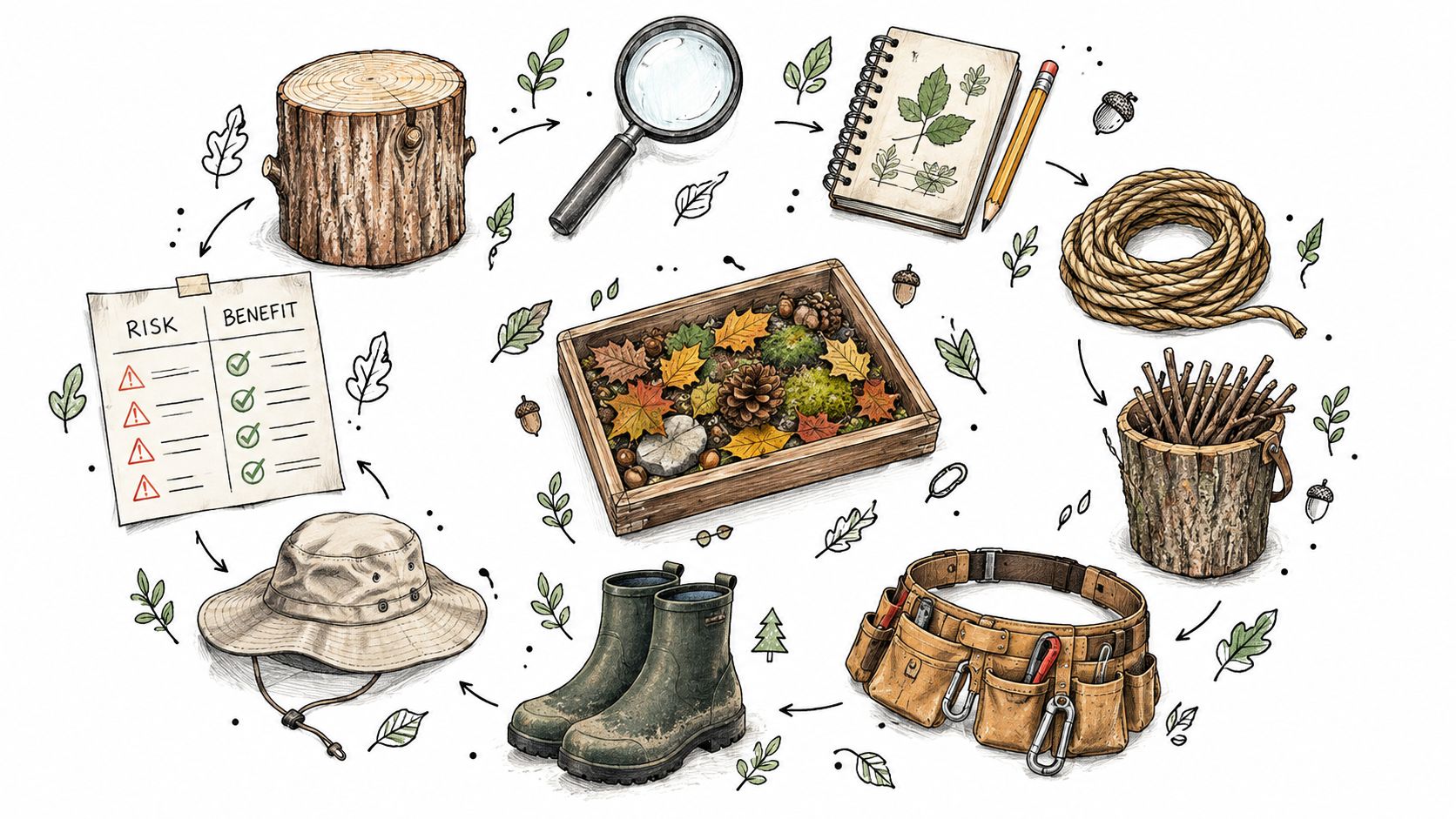
The ten resource categories below follow a practical decision-making order. They begin with planning, safety and safeguarding, then move through materials, seasonal experiences, clothing, EYFS links, nature knowledge, documentation and staff development. Outdoor learning can be adapted to a nursery garden, school grounds, local green space or another suitable environment. It doesn't require a particular facility or branded programme.
Examples are starting points, not prescriptions. Each setting should assess resources against its environment, children's needs, accessibility arrangements, current EYFS requirements and safeguarding policies.
1. Forest School Activity Planning Templates
A good planning template gives practitioners enough structure to prepare well without turning outdoor learning into a rigid lesson. It can prompt adults to record the intended learning, likely resources, the session sequence, environmental considerations and possible adaptations for individual children.
The strongest templates leave room for children's ideas. A plan might begin with an interest in fallen leaves, animal tracks or puddles, then develop through observation and conversation rather than following a fixed script. This supports intentional teaching while preserving the child-led quality that makes outdoor exploration valuable.
Templates associated with Forest Schools Scotland, Natural England outdoor-learning guidance and the OPAL framework can provide useful models. Settings should check whether a template suits early years children rather than copying a format designed for older pupils.
Make planning easy to use
A template that takes too long to complete usually becomes a form-filling exercise. Start with simple prompts, then add detail as staff become more confident. It should be accessible before, during and after an outdoor session, with space for a short reflection.
Useful prompts include:
- Purpose: What might children explore, practise or communicate?
- Preparation: What needs checking before children go outside?
- Flexibility: How could the experience change if children follow a different interest?
- Inclusion: What adaptations will support mobility, sensory, communication or emotional needs?
- Review: What did adults notice, and what could inform the next experience?
Forestry England provides free curriculum-linked resources for forest visits, with materials covering early years through KS3 and more than 20 downloads including activity packs, lesson plans, safety sheets and preparation materials (Forestry England's learning resources). These can inspire planning, but practitioners still need to adapt them to the children and environment in front of them.
2. Risk-Benefit Assessment Framework Tools
Traditional risk assessments often concentrate on what might go wrong. A risk-benefit assessment adds another question: what might children gain from taking part in a carefully managed challenge?
That doesn't mean ignoring hazards. It means considering whether a manageable challenge could support independence, coordination, decision-making or confidence, then deciding how adults will reduce the likelihood of serious harm. For example, handling natural materials may offer sensory and problem-solving opportunities, but adults still need to assess sharp edges, contamination, allergies, supervision and how the materials will be stored.
The Forest Schools Association's professional principles and criteria give Forest School practice a recognised structure rather than treating it as unplanned outdoor play (Forest Schools Association principles and criteria). Play Safety Forum guidance can also help teams discuss the difference between a serious hazard and a reasonable challenge.
Build risk literacy gradually
Staff need practical opportunities to talk through decisions, not just a document to sign. Begin with familiar, lower-risk experiences and review what adults noticed before introducing more complex challenges. Children can contribute by identifying slippery surfaces, unstable objects or appropriate ways to carry materials, provided the discussion matches their age and communication needs.
Practical rule: A risk-benefit assessment should explain why an experience is worthwhile, which hazards matter, how adults will manage them and when the decision needs reviewing.
Record near misses as well as incidents. A near miss may reveal that a boundary is unclear, a resource has deteriorated or supervision needs adjusting. Parents should receive clear information about the setting's approach so they understand that thoughtful challenge is different from careless exposure to danger.
3. Safeguarding and Outdoor Supervision Checklists
Outdoor supervision needs the same seriousness as indoor safeguarding, with additional attention to boundaries, changing weather, unfamiliar spaces and children's differing levels of independence. A concise checklist helps adults complete essential checks before children begin exploring.
The checklist might cover the condition of the ground, poisonous or harmful plants, water, gates, visibility, weather, clothing, first-aid arrangements, communication methods and children's individual medical or care needs. It should also state what happens if a child becomes distressed, wanders from the agreed area or needs to return indoors.
Keep the checklist visible
A laminated or waterproof version near the outdoor entry point is more useful than a long document hidden in a policy folder. Staff should know which checks happen before every session, which are reviewed seasonally and which are specific to an outing or local site.
Supervision arrangements must reflect children's ages and needs. In England, the EYFS minimum adult-to-child ratios for group and school-based nurseries are 1:3 for children under two, 1:5 for two-year-olds and 1:8 for children aged three and over. A ratio of 1:13 for three- and four-year-olds is permitted only when a suitably qualified practitioner is working directly with the children (EYFS statutory framework guidance).
Ratios are a minimum, not a complete supervision plan. A setting may need additional adults because of the layout, a child's health needs, the distance from the building or the complexity of the activity. Checklists should connect directly to the safeguarding policy and be reviewed after incidents, near misses, staffing changes or changes to the environment.
4. Loose Parts and Natural Materials Kits
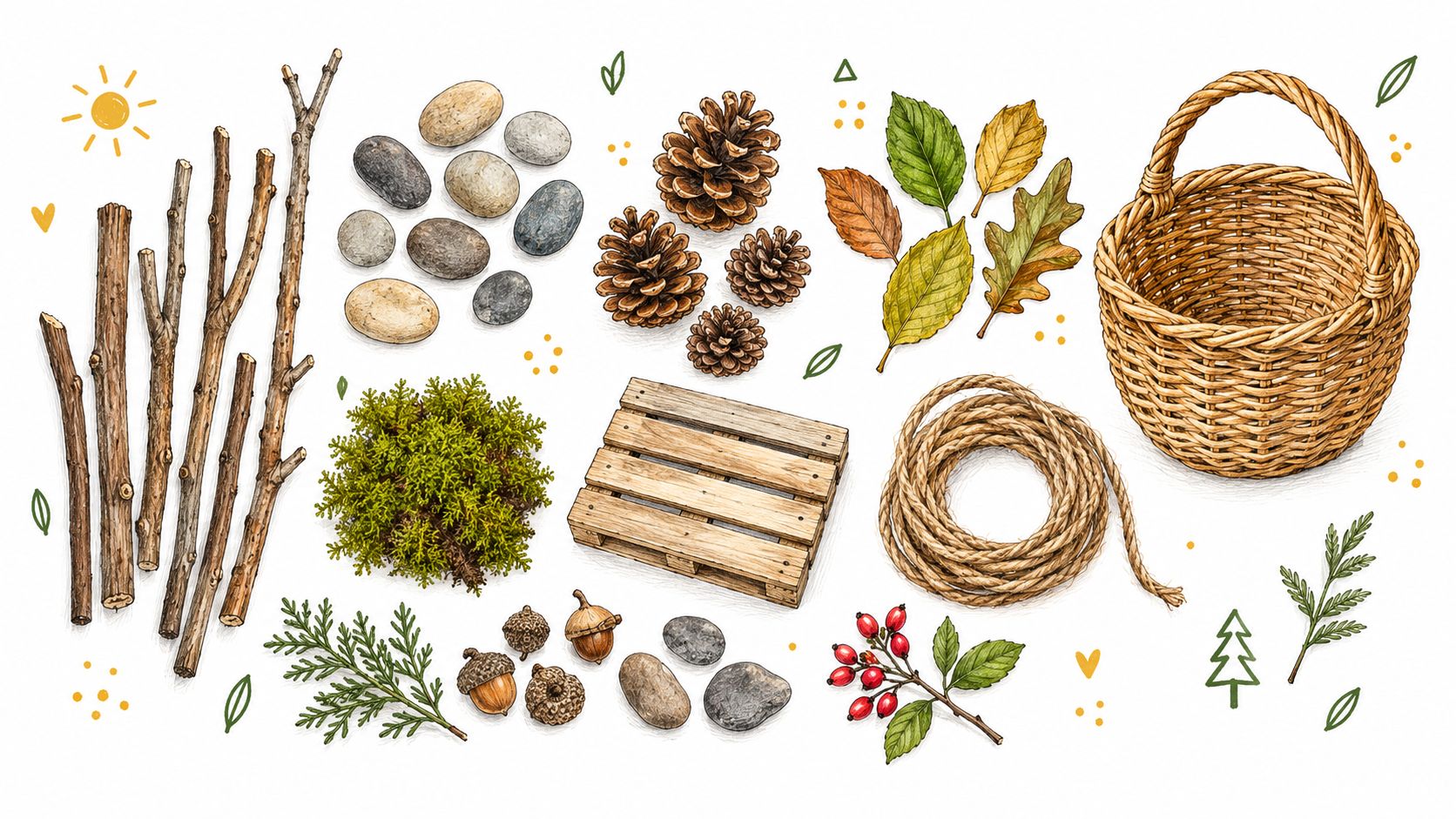
Loose parts give children materials that can become many things. A stick may become a measuring tool, a pretend cooking utensil or part of a construction. Stones, leaves, bark, pinecones, logs, water, sand and clay can support storytelling, sorting, building, mark-making and collaborative problem-solving without dictating one correct outcome.
The trade-off is that open-ended resources require more thoughtful supervision than a toy with a clearly defined purpose. Adults need to check for splinters, sharp edges, mould, deterioration, contamination and choking risks. Natural materials must be suitable for the children using them, particularly babies and toddlers who may mouth objects.
Choose versatility over volume
A small, carefully checked collection is often more useful than a large assortment that children can't access independently. Store materials so children can see and return them, then rotate some items according to the season or current interests. Avoid presenting adult-made examples as the expected result, because that can narrow children's ideas.
Children can help collect, sort and prepare materials when adults can supervise safely. A practitioner might invite children to find smooth objects, group leaves by appearance or decide how to organise a basket. Documentation through photographs and short observations can show how a simple resource supported language, cooperation or persistence.
For an early years setting, the most important question isn't whether a kit looks attractive. It's whether children can use the materials safely, creatively and accessibly within the available space. Information about Forest School and early years outdoor learning can help parents understand the wider approach, but every setting must explain its own resources and safeguards accurately.
5. Seasonal Outdoor Learning Lesson Plans
Seasonal lesson plans can help adults notice change over time. Children might observe how a tree, patch of ground or familiar outdoor area looks different as weather, light and wildlife patterns change. The learning can include vocabulary, counting, movement, drawing, music, storytelling and early scientific thinking.
Useful examples include Woodland Trust Nature Detectives activities, RSPB Big Garden Birdwatch materials, Coppice Outdoor Nursery activity collections and Early Years Out seasonal resources. Forestry England also maps learning resources from EYFS through KS4, giving settings a structured way to connect early exploration with later environmental learning (Forestry England's curriculum-linked forest visit resources).
Use prompts, not scripts
A seasonal plan should give adults an invitation rather than a required outcome. If children become fascinated by worms during a planned leaf activity, that discovery may offer richer learning than completing every step on the page. Practitioners can return indoors with photographs, collected observations or children's questions and use them to extend provision.
“The best seasonal plan leaves enough space for an unexpected discovery.”
Connect outdoor experiences with indoor opportunities where appropriate. Children might revisit a sound they heard, make marks inspired by natural patterns or look at a picture book related to something they observed. Parents looking for an explanation of the benefits of outdoor learning in the early years can use these links to understand how outdoor experiences can support broader development.
Seasonal plans also need adaptation for accessibility, weather and individual interests. A child who can't comfortably move across uneven ground may observe, photograph, sort or communicate findings from a carefully chosen position. Participation doesn't have to look the same for every child.
6. All-Weather and Clothing Guidance Resources
Outdoor learning becomes more consistent when families know what children need to wear and why. Clothing guidance should be practical, visual and specific, covering layers, waterproof outerwear, suitable footwear, hats, gloves, spare clothes and arrangements for wet items.
The aim isn't to make parents buy expensive specialist clothing. Settings can suggest second-hand options, shared supplies or cost-conscious alternatives where appropriate. They should also explain how clothing will be labelled, stored, dried and returned, because a waterproof coat is only useful if children can access it and adults can identify it.
Adapt the experience, not the expectation
Rain, wind and cold may change what children do outdoors, but they don't automatically remove the value of being outside. Adults can shorten an experience, move to a more sheltered area, offer different materials or focus on observation rather than energetic movement. Extreme weather and medical needs require clear professional judgement and may call for an alternative plan.
England's EYFS requires providers to give all children daily access to an outdoor play area. If that isn't possible, providers must plan and take outdoor activities daily, making outdoor provision part of everyday early years practice rather than an occasional extra (the EYFS statutory framework for group and school-based providers).
A simple parent guide might show clothing in layers and state what happens when items become wet. Children can gradually learn to recognise what they need, practise dressing and ask for help. Information about outdoor areas and outdoor play may help families form questions for their own early years setting, without assuming that every nursery has the same environment.
7. Outdoor EYFS Area Mapping and Planning Resources
Outdoor spaces can support all seven EYFS areas when adults observe how children use them and plan thoughtfully. Communication and Language may develop through shared discoveries and new vocabulary. Physical Development may be supported through movement, balance and handling materials, while Personal, Social and Emotional Development can grow through cooperation, confidence and managing feelings.
Literacy, Mathematics, Understanding the World, and Expressive Arts and Design also have a natural place outdoors. Children may make marks, compare quantities, notice patterns, investigate living things, create sounds or use objects in imaginative play. The resource is not a list of equipment. It's a planning map that helps adults notice learning possibilities in what is already available.
Start with the space you have
An audit should record what children can reach, where they can move safely, which areas offer shelter and how the environment works in different weather. Staff can then choose one or two development priorities instead of trying to redesign everything at once.
For example, a team might begin by making communication more visible through picture prompts, real objects and repeated vocabulary. Another setting may focus on mathematical thinking by offering opportunities to compare size, capacity, position or pattern using loose parts.
The EYFS is the statutory framework for early years provision from birth to five, and this guide to the EYFS framework can help parents understand the language practitioners use. Outdoor planning should support children's development without turning every moment into an assessment task.
Review the map through observation. If children consistently avoid an area, adults should ask whether the layout, access, sensory experience or available resources needs changing. Parent communication can also explain how outdoor play connects with learning without suggesting that children need formal worksheets to benefit.
8. Nature Knowledge and Identification Guides
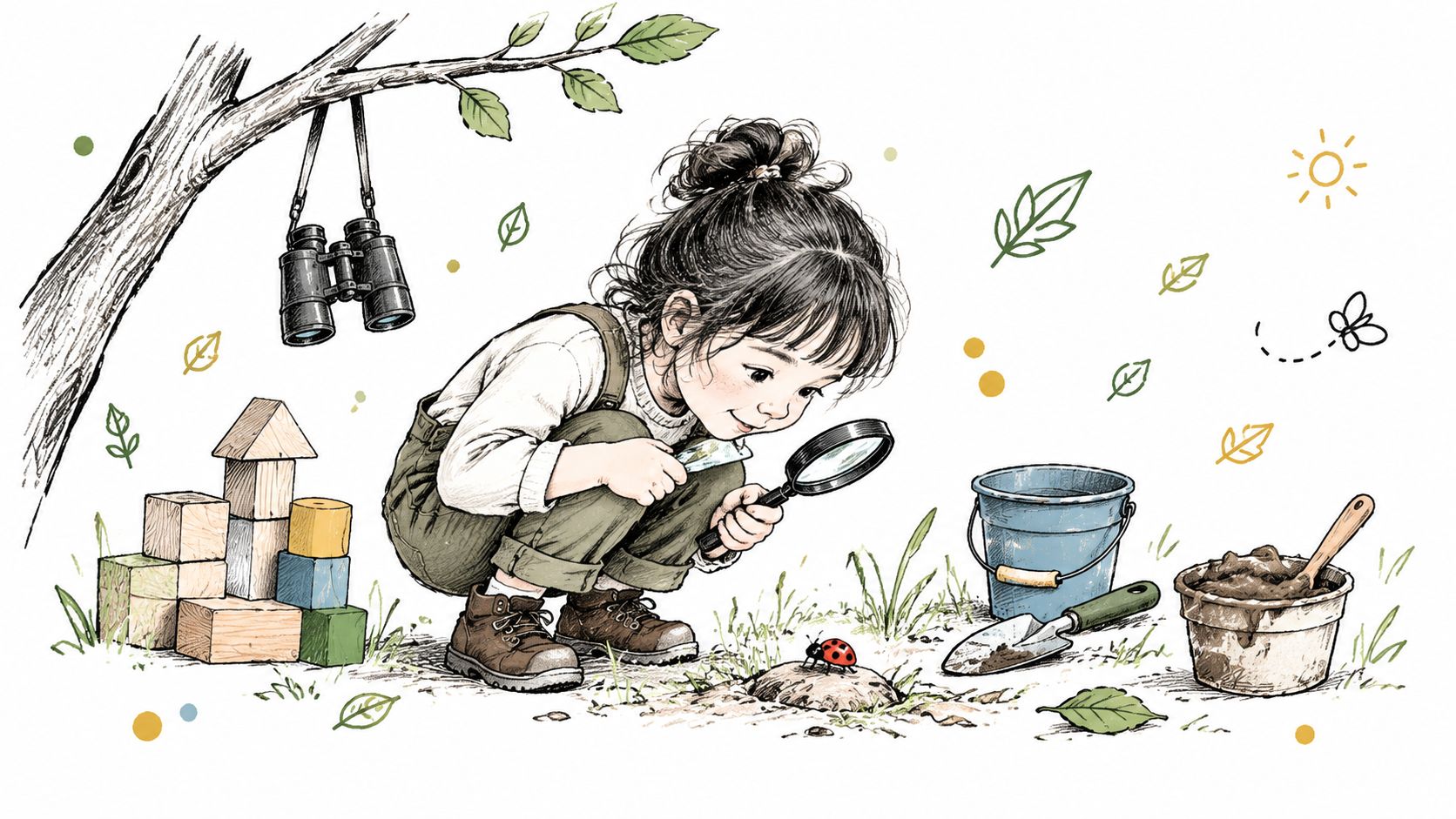
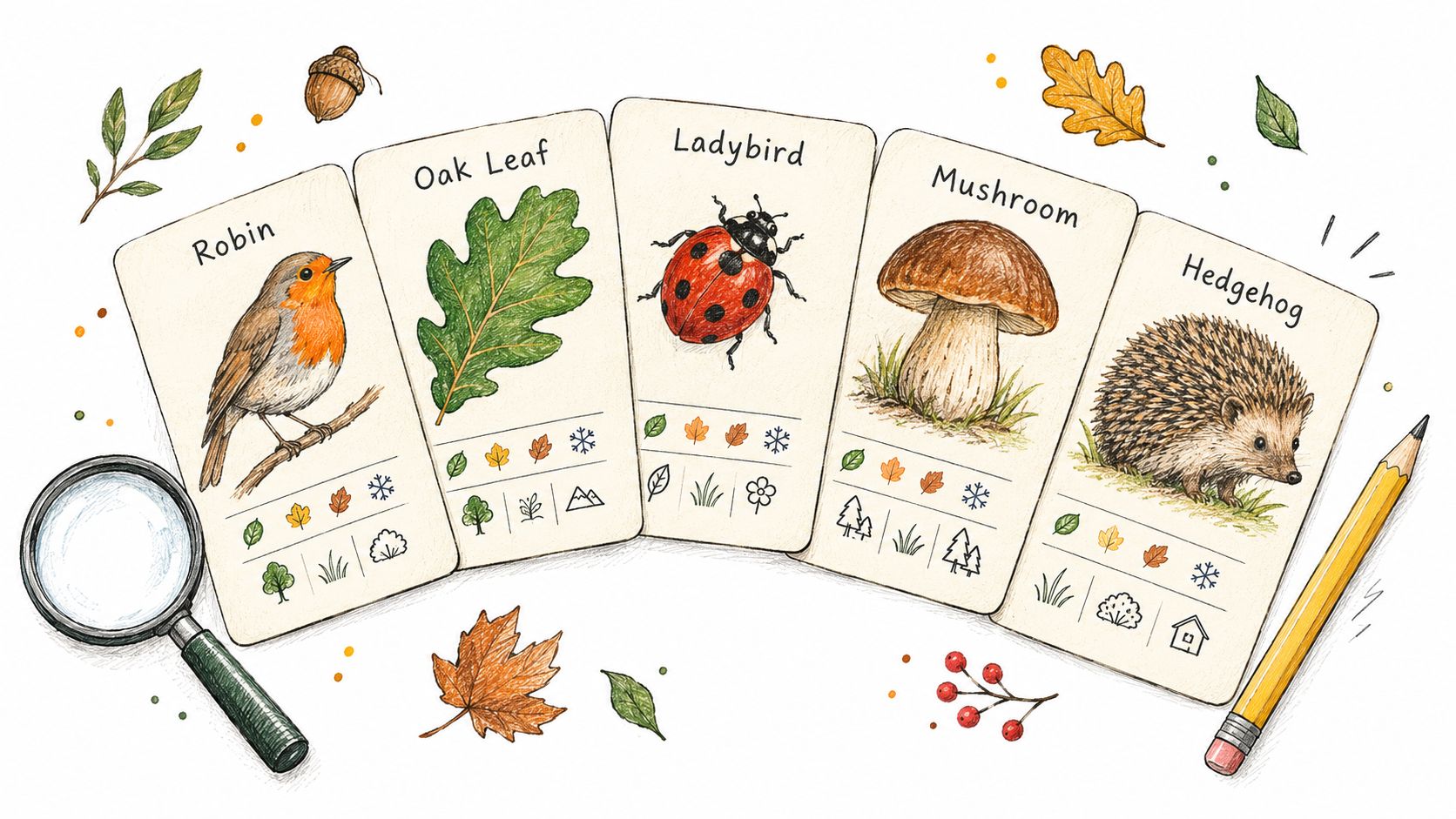
Identification guides give children and adults a shared language for noticing the natural world. A robin, oak leaf, ladybird, mushroom or hedgehog can become the starting point for questions about colour, movement, habitat, food and change. The guide should support observation rather than encourage children to handle every plant or creature they find.
Woodland Trust species guides, RSPB bird resources, portable Collins Gem guides and carefully selected digital tools such as iNaturalist can all offer useful reference points. Choose resources that reflect the local environment and are readable at a glance, rather than buying a broad guide that children rarely use.
Observe first, identify second
Practitioners can ask children what they notice before naming a species. This encourages close attention and avoids turning nature study into a test with one correct answer. Children might compare two leaves, describe a bird's movement or record where an insect was found.
Safety remains essential. Children shouldn't eat unidentified plants, touch fungi or disturb animals' nests. Digital identification apps can be useful for adults, but they shouldn't replace supervision or local safeguarding knowledge.
A setting-specific guide can be more engaging than a generic poster. Staff might photograph common local species, add children's descriptions and include reminders about safe observation. Nature knowledge also supports inclusion when children can contribute through looking, listening, pointing, photographing, drawing or using communication aids.
Forestry England's early years materials include activities related to tree growth, carbon storage, wellbeing and sustainable forest management, showing how nature resources can connect simple observations with wider ideas (Forestry England's learning resources for forest visits). The adult's role is to keep those ideas understandable and grounded in what children can see.
9. Outdoor Learning Observation and Documentation Systems
Outdoor learning produces rich evidence, but practitioners can miss it if documentation systems are too complicated. A child who persists with a construction, negotiates the use of a basket or describes a change in the weather may be showing meaningful development without completing a planned activity.
Simple observation sheets, photographs, learning journals and portfolios can capture these moments. Digital platforms such as Tapestry may help settings share observations with parents, while paper records can be more practical outdoors. The choice matters less than whether adults record what the child did, said, noticed or attempted.
Record the learning, not just the activity
A photograph of children outside says little on its own. A short note can explain how one child used new vocabulary, solved a problem with another child or changed approach after a first attempt failed. Link observations to relevant EYFS areas where useful, but avoid forcing every observation into multiple categories.
A useful observation answers three questions: What did the child do? What might this show? What could happen next?
Staff deployment needs to include time for observation. If adults are always focused on moving resources, managing clothing or completing checks, they may not have enough attention for children's thinking. Use observations to refine future planning, not just to create a record for parents.
Photography requires consent, secure storage and adherence to the setting's data protection policy. Children can also help reflect on their experiences by choosing a photograph, explaining a creation or deciding what they'd like to investigate next. This gives documentation a participatory purpose rather than making it an adult-only process.
10. Forest School Practitioner Training and Certification
Resources work best when adults understand how to use them. Practitioner training can cover Forest School principles, child development, safeguarding, risk management, nature knowledge, practical outdoor skills and ways to support child-led learning.
The Forest School Association states that its six core principles were agreed by the Forest School community in 2011 and underpin criteria for national professional standards (the Forest School Association's full principles and criteria). A short activity course isn't necessarily the same as professional development in Forest School practice.
Assess training by its practical value
When comparing courses, ask whether they include practical outdoor delivery, early years experience, safeguarding and risk-benefit thinking. A qualification may look impressive on paper but offer limited value if it doesn't help staff make decisions in the actual environment where children learn.
Training should also fit the whole team. One practitioner may attend a course, but colleagues still need to understand boundaries, communication systems, clothing arrangements and the setting's approach to challenge. Mentoring, shared reflection and refresher learning can help knowledge spread beyond one individual.
A strong programme respects local context. The needs of an urban nursery garden differ from those of a woodland site, and a group of babies requires different planning from a group of preschool children. Parents can ask who leads outdoor learning, what training staff have completed and how the setting keeps practice current.
Professional development should never be treated as a substitute for safeguarding procedures. Training supports judgement, but settings still need clear policies, suitable staffing, environmental checks and an honest review of what their team can deliver safely.
10-Item Forest School Resource Comparison
| Resource | Core features | Benefits (quality / UX) | Best for / Target audience | Implementation / cost & considerations | Unique selling point |
|---|---|---|---|---|---|
| Forest School Activity Planning Templates | Risk checklists, EYFS-linked learning outcomes, sequencing, observation & reflection sheets, weather adaptations | Consistent safeguarding, purposeful outdoor learning, Ofsted evidence, staff confidence | Practitioners, room leaders, curriculum planners | Requires staff training; initial time to adapt; keep templates simple and localised | EYFS-aligned, structured outdoor planning |
| Risk-Benefit Assessment Framework Tools | Hazard ID, benefit evaluation, mitigation strategies, dynamic assessments, documentation cycles | Encourages balanced decisions, builds resilience, evidence-based risk management, parental reassurance | Senior staff, risk leads, Forest School practitioners | Cultural shift needed; training and ongoing refreshers; clear parent communication | Focuses on developmental benefits as well as risk |
| Safeguarding & Outdoor Supervision Checklists | Pre-session checks, supervision ratios/positions, weather protocols, emergency & medical procedures | Quick reference for safety, reduces oversights, consistent practice, regulator reassurance | All staff, new/temporary staff, safeguarding leads | Must be regularly reviewed; train staff; use weatherproof formats | Fast, practical tool for session-level safety control |
| Loose Parts & Natural Materials Kits | Natural/reclaimed materials, storage solutions, tools for water/sand play, low-plastic focus | Stimulates creativity, problem-solving, inclusive play, sustainable and low-cost | Practitioners promoting child-led play, outdoor areas | Ongoing sourcing/rotation; hygiene and safety checks; storage and supervision needs | Open-ended, nature-connected play materials that spark imagination |
| Seasonal Outdoor Learning Lesson Plans | Season-structured activities, EYFS mapping, age-differentiated ideas, materials lists, weather adaptations | Reduces planning load, multi-sensory seasonal learning, supports year-round outdoor use | Busy practitioners, less-experienced outdoor educators | Adapt to local context to avoid formulaic use; customise resources | Ready-to-use, seasonally relevant EYFS-linked activities |
| All-Weather & Clothing Guidance Resources | Clothing layers, waterproof kit lists, temperature thresholds, parent templates, activity adaptations | Enables continuous outdoor provision, reduces parental concern, practical staff guidance | Managers, parents, all staff delivering outdoor sessions | Upfront kit costs; storage/drying/laundry logistics; parent buy-in needed | Practical roadmap to make "all-weather" truly usable |
| Outdoor EYFS Area Mapping & Planning Resources | EYFS-to-outdoor mapping templates, audits, layout plans, resource lists, inclusion checks | Ensures balanced provision, links outcomes to outdoor spaces, identifies gaps | Curriculum leads, managers, setting planners | Time and resources to implement; may need space redesign or phased rollout | Holistic mapping of EYFS areas into the outdoor environment |
| Nature Knowledge & Identification Guides | Illustrated ID cards/apps, seasonal species lists, habitat/lifecycle notes, safety flags, waterproof formats | Boosts nature literacy, vocabulary, inquiry and observation skills | Practitioners, children, parent volunteers | Staff familiarisation required; protect physical guides or ensure device access | Child-friendly local species ID for on-the-spot exploration |
| Outdoor Learning Observation & Documentation Systems | Observation sheets, EYFS links, photo templates, digital portfolios, parent-sharing tools | Captures outdoor learning evidence, supports assessment, enhances parent engagement | EYFS leads, assessors, room practitioners | Time-intensive; training on observations; possible tech cost and weather-proofing equipment | Direct link between outdoor play and Ofsted/EYFS evidence |
| Forest School Practitioner Training & Certification | Blended theory + practical, risk & safeguarding modules, supervised practice, accredited levels | Professional confidence, recognised credentials, consistent pedagogy across staff | Staff development leads, aspiring Forest School practitioners | Significant financial & time investment; plan cover for trainees; ongoing CPD | Accredited pathway to professionalise and sustain outdoor practice |
Build a Resource Set That Grows With Children
A useful collection of forest school resources doesn't need to arrive all at once. Begin with the foundations that protect children and help adults make consistent decisions. That means clear safeguarding procedures, supervision arrangements, environmental checks and risk-benefit assessments that explain both the potential hazards and the value of an experience.
Next, add planning resources that are simple enough to use regularly. Activity templates and seasonal prompts can support intentional learning without removing children's choice. A good plan should help adults prepare, then give them permission to respond when children discover something unexpected.
Versatile resources usually offer better long-term value than materials designed for one activity. Loose parts, natural objects, paper, clipboards, magnifiers, containers and drawing materials can support many interests, provided adults check them carefully and make sensible adjustments for age, development and accessibility. The right question isn't “What can this product do?” It's “What can children do with it, and how will adults support that play?”
Clothing guidance deserves the same attention as activity planning. Families need clear information about layers, waterproof items, spare clothes and wet-weather arrangements. Settings need a practical way to store, dry and identify clothing. When these routines work, children can spend more time exploring and less time waiting for adults to solve avoidable problems.
Staff training should grow alongside the resource collection. Practitioners need confidence to supervise, recognise meaningful challenge, adapt experiences, support children with additional needs and explain outdoor learning to parents. A trained adult with a modest set of resources can often offer richer experiences than an underprepared team with a crowded equipment store.
Observation and documentation should then show whether the approach is working for the children who use it. Look for evidence of curiosity, communication, cooperation, movement, independence and sustained involvement. Also look for children who are consistently left out, overwhelmed or unable to access the experience. That information should lead to changes in planning, space, materials or support.
Review every resource against five practical questions:
- Environment: Does it suit the space, surfaces, weather and access arrangements?
- Children: Can children of different ages, abilities and communication styles use it?
- Staff confidence: Do adults understand how to supervise and extend it?
- Safeguarding: Are checks, boundaries, consent and data protection clear?
- EYFS purpose: Can the resource support meaningful development without forcing formal learning onto play?
Parents can ask any early years setting how it approaches outdoor learning, how adults supervise children and how experiences connect with development. They can also ask how the setting adapts provision for babies, toddlers, children with additional needs and children who don't initially feel comfortable outdoors.
Happy Tree Academy is a day nursery in Northwood offering early years care and education for children aged 3 months to 5 years, with play-based experiences, meals and snacks, and an outdoor-learning and Forest School offer described by the nursery. Families considering childcare can learn more about the setting's facilities, opening hours, funding information and approach by contacting the nursery directly.
Happy Tree Academy offers early years care and education for children aged 3 months to 5 years in Northwood, including play-based experiences and outdoor learning. If you're comparing childcare options and want to understand how the setting may support your family, visit Happy Tree Academy to find out more and arrange an enquiry.